Inspired by life in underprivileged areas of Manaus, the artist creates images that bring together art, community, and the challenges of urban infrastructure in the Amazon.
In the underprivileged community of Mossoró, southern Manaus (AM), the effect of recurring floods is magnified by the lack of sanitation that have a strong impact on people’s lives.
When it rains heavily in the area, the water unapologetically floods the alleys, covers the streets, and breaches the houses. “In many cases, residents spend hours trying to protect furniture, appliances, and their homes. Today, for many people, the rain has become an even greater source of ongoing concern,” reports Sarah Campelo, artist, activist, and resident of the area.
It is based on this reality, in which she was born and raised, that Sarah shapes her perspective on art, the city, and the Amazon. The resulting production affirms the existence of a territory marked by inequalities, but also filled with culture, imagination, and creative potential.
By using acrylic on canvas, photography, and digital experimentation, the artist expands her practice and also arranges mural productions. Her work stems from careful observation of her surroundings, resulting in scenarios that traverse imagination and experience, articulating painting, color, and composition to shift what is seen towards what remains in the realm of possibilities.
Sarah spoke to the Concertation about her work, her experience of living in an Amazonian city, and in particular, about underprivileged areas as educational spaces.
Urban Amazon: an invisible reality claiming its place
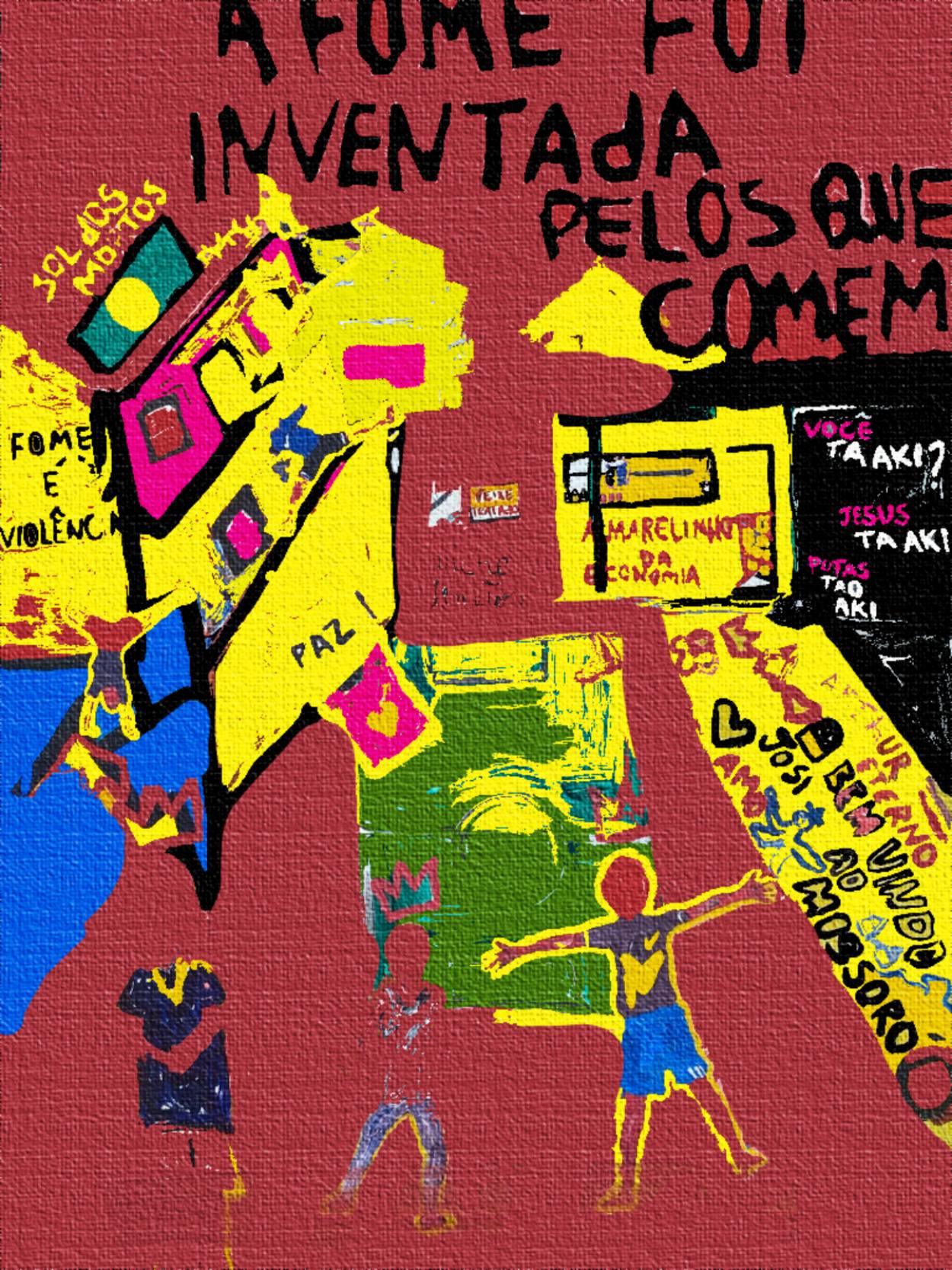
Viewed from afar in satellite images, global speeches, or institutional campaigns, the Amazon is often reduced to just a forest. From the outside, the region is seen as mere landscapes composed of forests, rivers, and biodiversity, almost always uninhabited. It is in opposition to this framework that Sarah carries out her work.
Book “A fome foi inventada” is an example of this reaffirmation. Far from the green environments to which the imagination about the Amazon is usually reduced, the artist portrays the daily life of underprivileged communities, with their homes, businesses, and children interacting. The presence of Carolina Maria de Jesus’s sentence, “hunger was invented by those who eat,” however, shifts the focus and introduces a critical dimension of reflection on inequality and social structure.
Stories of the Amazons told in the first person
But Sarah goes beyond social criticism: she makes the territory – and those who live in it – the protagonist. For her, what’s at stake is how it is perceived and, consequently, thought about. By telling the Amazon´s story in the first person, she breaks with the logic that turns the region into an object of external observation, often disconnected from the people who live there. And in this gesture, her artistic production also takes shape as a political practice.
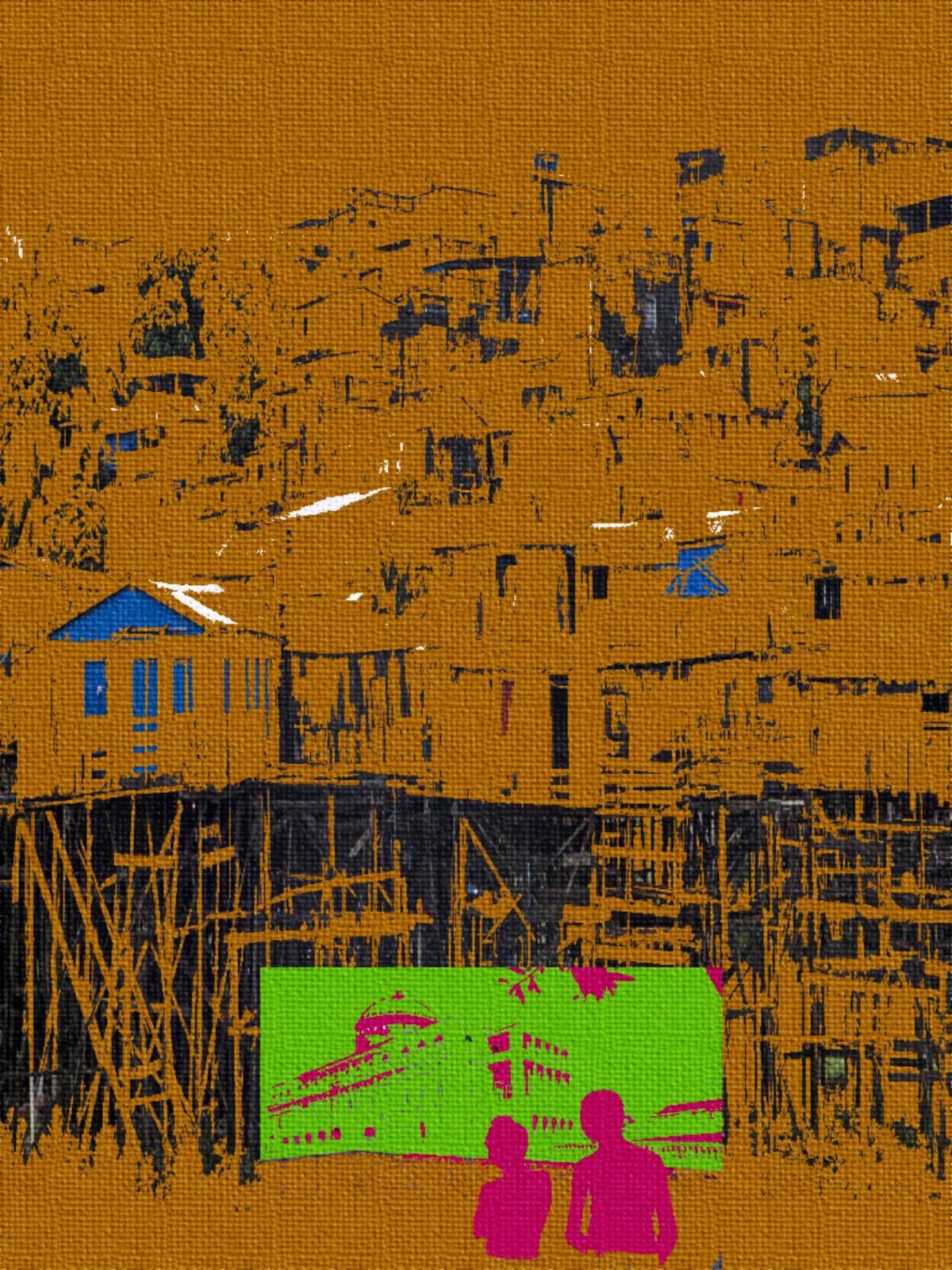
In “Onde possamos sonhar”, the artist works with the juxtaposition of universes. The artwork depicts two boys in front of the Amazonas Theater, in an image that overlays the context of the underprivileged areas, creating a contrast between the postcard image and the real city. The operation reveals socio-spatial inequality and highlights the gap between dominant narratives about the Amazon and its inhabitants.
The role of visual language in understanding the multiple (and alternative) realities of the Amazon
The artist believes that the reality of urban Amazon remains on the margins of dominant narratives not only due to lack of information, but to limited imagination. “What we can’t see or can´t imagine rarely becomes a priority,” she says.
In this sense, visual language becomes a way to extend the debate. Her works reconfigure landscapes and suggest alternative ways of existing for the same spaces. In many of them, the community appears safer, more vibrant, and more colorful, not as a denial of reality, but rather as an expression of hope.
This choice is not by chance. Her works are not limited to realistic depictions, expanding the boundaries of what one expects to see. In this context, art functions as a language capable of suggesting alternative scenarios, paving the way for new narratives to emerge.
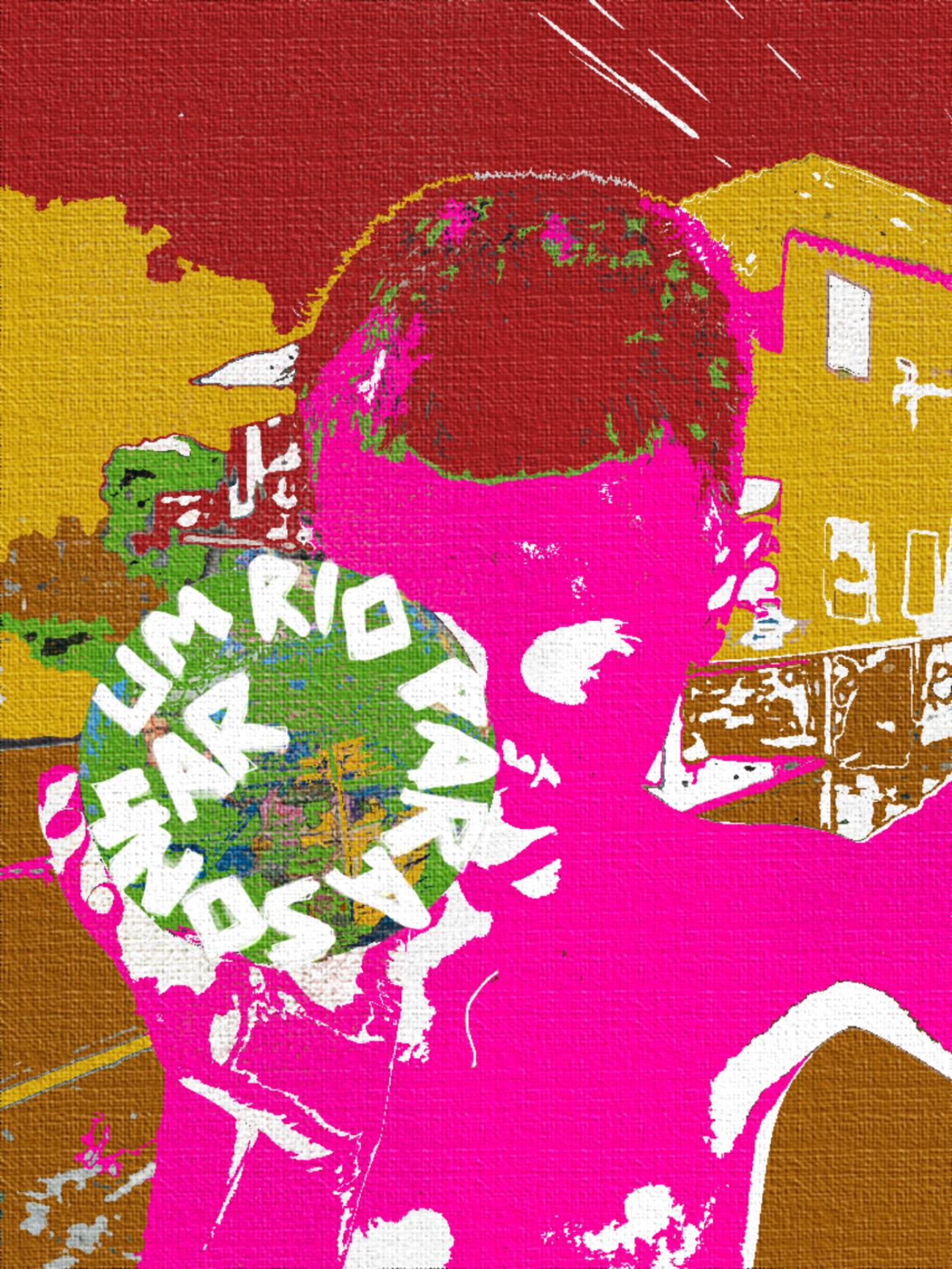
Work “Um rio para sonhar” is an example of this perspective. The artist uses a photograph as a starting point to build a landscape that approaches the universe of imagination. The image speaks directly with the community’s experience, where the igarapé stream, now degraded, was once a place for social interaction, leisure, and subsistence. “We keep thinking about what this river would be like if it were clean,” Sarah says. The image projects a possibility
The absence of urban sanitation as a political and artistic issue
If imagination defines priorities, it is in everyday life that the effects of invisibility become most evident. In Mossoró, the precariousness of the sanitation infrastructure is an ongoing experience that permeates bodies, homes, and relationships. Sarah explains that “the igarapé stream, which is nearly an open-air garbage dump, causes the flooding of houses with water contaminated by feces, rats, and trash during the rainy season, causing illness, loss of personal items, and disruption of activities and leisure.”
This is a condition that directly affects people’s health, mobility, and ability to remain in the community. Floods disrupt routines, disorganize work, and severely impact those already living in vulnerable situations. “And part of the issue of infrastructure, of basic sanitation, is not discussed, which concerns the mental health of people who live in situations like these,” the artist adds.
She also sees a strong connection between this dynamic and the increasingly frequent extreme weather events in the Northern Region of Brazil, with strong cycles of flooding and drought that create continuous instability, redefine daily life, impose limits on the possibilities of tomorrow, and keep residents in a state of anxiety. “We live through the drought in fear of the flood, and we live through the flood in fear of the drought. We´re always expecting the worst.”.
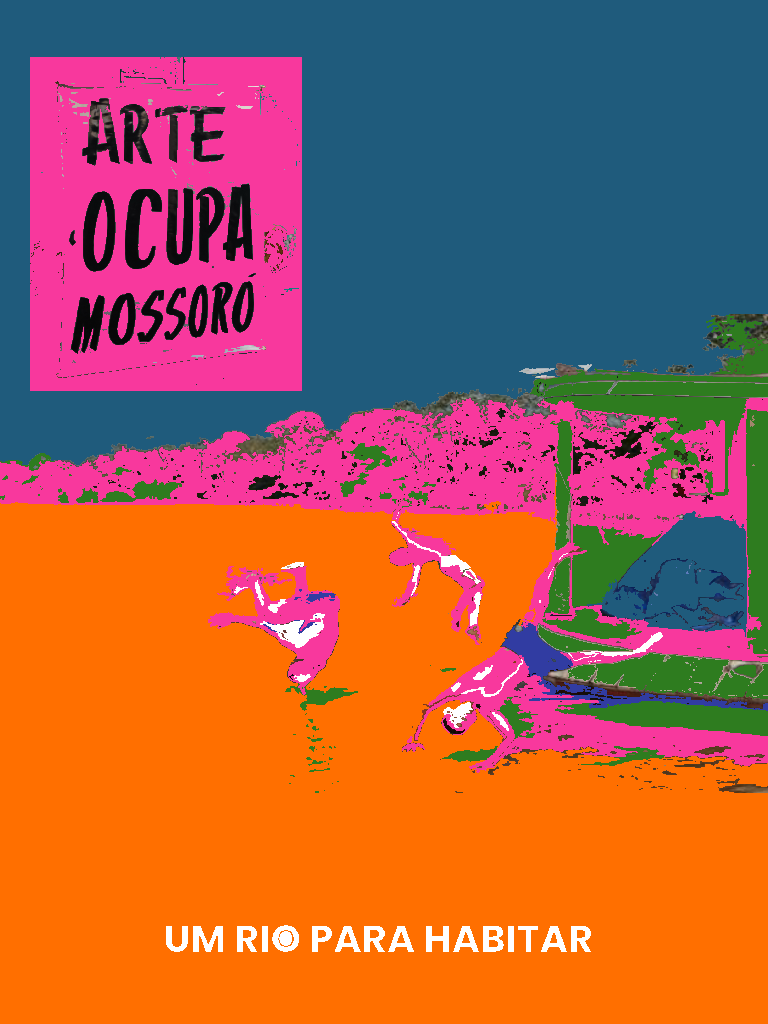
In this context, in “Um rio para habitar,” the igarapé stream once again becomes the focus of an intervention that envisions it as clean, restored, and in balance with local ways of life. The contrast between colors and visual layers creates a tension between the present and what does not yet exist.
Arte Ocupa: underprivileged areas as places of occupation and creation
It was also from the reality of Mossoró that Arte Ocupa [Art Occupies] emerged, a project co-created by the artist based on her perception of the scarcity of cultural facilities in the region and of art as a transformative experience. The proposal is based on the idea of transferring art from institutional spaces to the underprivileged areas, occupying streets, walls, and houses to enhance its transformative power.
By carrying out actions such as creating murals, exhibitions in open areas, and itinerant interventions, the initiative broadens access to artistic production and reinforces a central notion in Sarah’s work: underprivileged areas are not just a setting, they are active environments for creation.
Through actions built with the community, Sarah makes art a collective experience
In all her projects, Sarah develops methodologies based on listening and collective construction with the community in order to design futures. She doesn’t follow a predefined model, because she understands that the process matters as much as the outcome: “Nothing I do is ready-made. I ask them how they want things to be, what makes sense to them.”
This choice alters the traditional logic of artistic production. The audience ceases to be passive and begins to act as co-author. By sharing decisions and processes, the artist expands participant autonomy and creates conditions for the initiatives to be continued beyond her presence.
In Mossoró, art and politics go hand in hand
The logic of collective construction also guides how Sarah addresses political matters in her projects. By avoiding a direct or confrontational approach, the artist develops strategies that bring the debate closer to the community’s daily life. When dealing with complex issues, she seeks to translate abstract concepts into accessible language, adapted to different audiences.
The artist describes her approach as a silent way of doing politics, which mobilizes cultural, religious, and affective references and builds bridges that allow for the discussion of structural issues without breaking ties with people. Spaces for dialogue broaden the reach of political debate and reinforce the role of art as a tool for mobilization and social transformation.
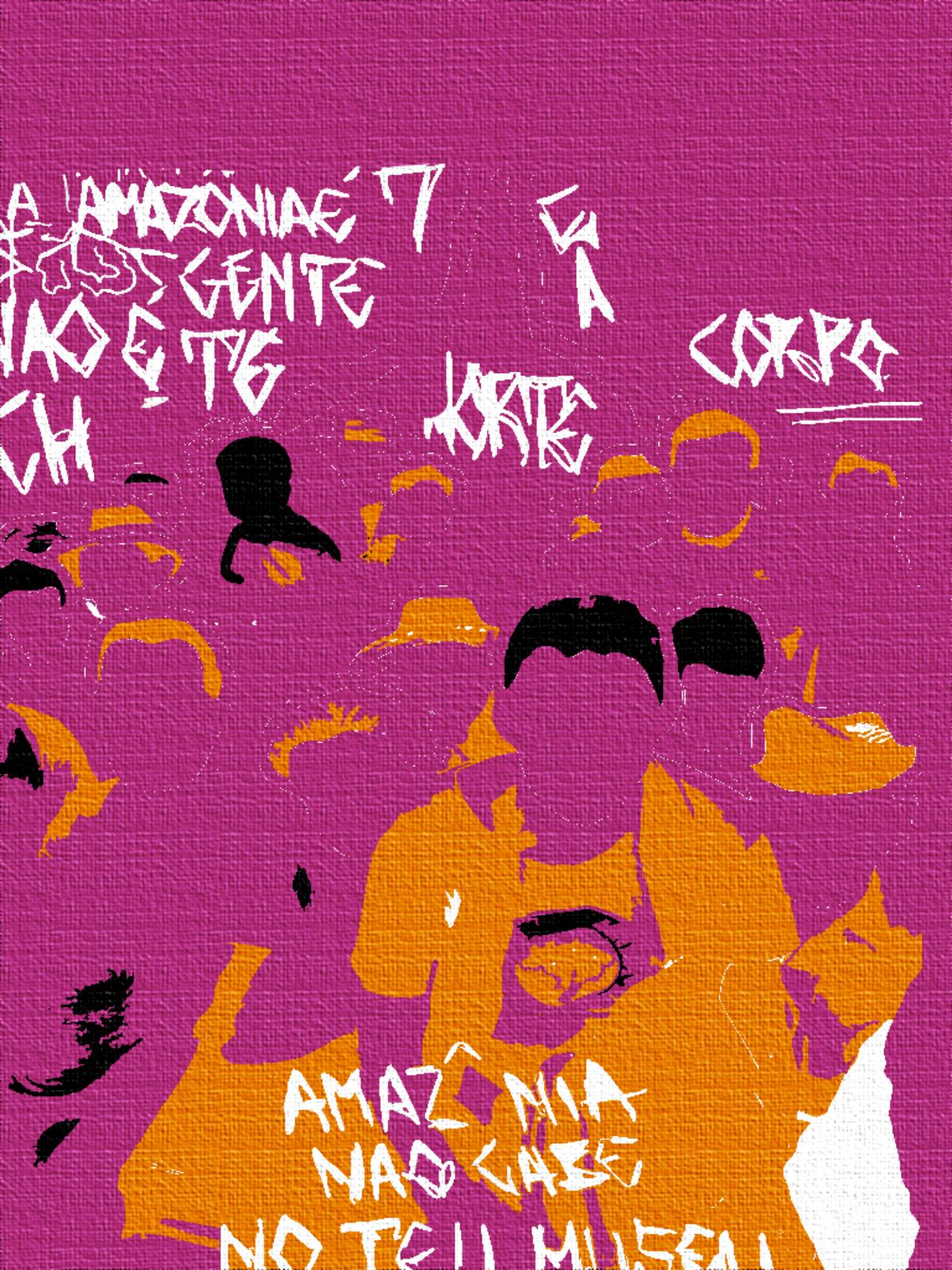
In Mossoró, art becomes a way to collectively address the challenges of the territory and to assert other possibilities of existence for the Amazonian underprivileged areas. By connecting structural debates to the everyday experience of the community, Sarah Campelo builds pathways for participation and belonging that strengthen both the political and affective dimensions of her work.
By means of paintings, murals, interventions, and shared processes, her work reveals that imagining fairer futures is also a way to begin building them.