Sarah Campelo turns Amazonian underprivileged areas into a space for art and political affirmation

Inspired by life in underprivileged areas of Manaus, the artist creates images that bring together art, community, and the challenges of urban infrastructure in the Amazon.

Plenary sessions in comics

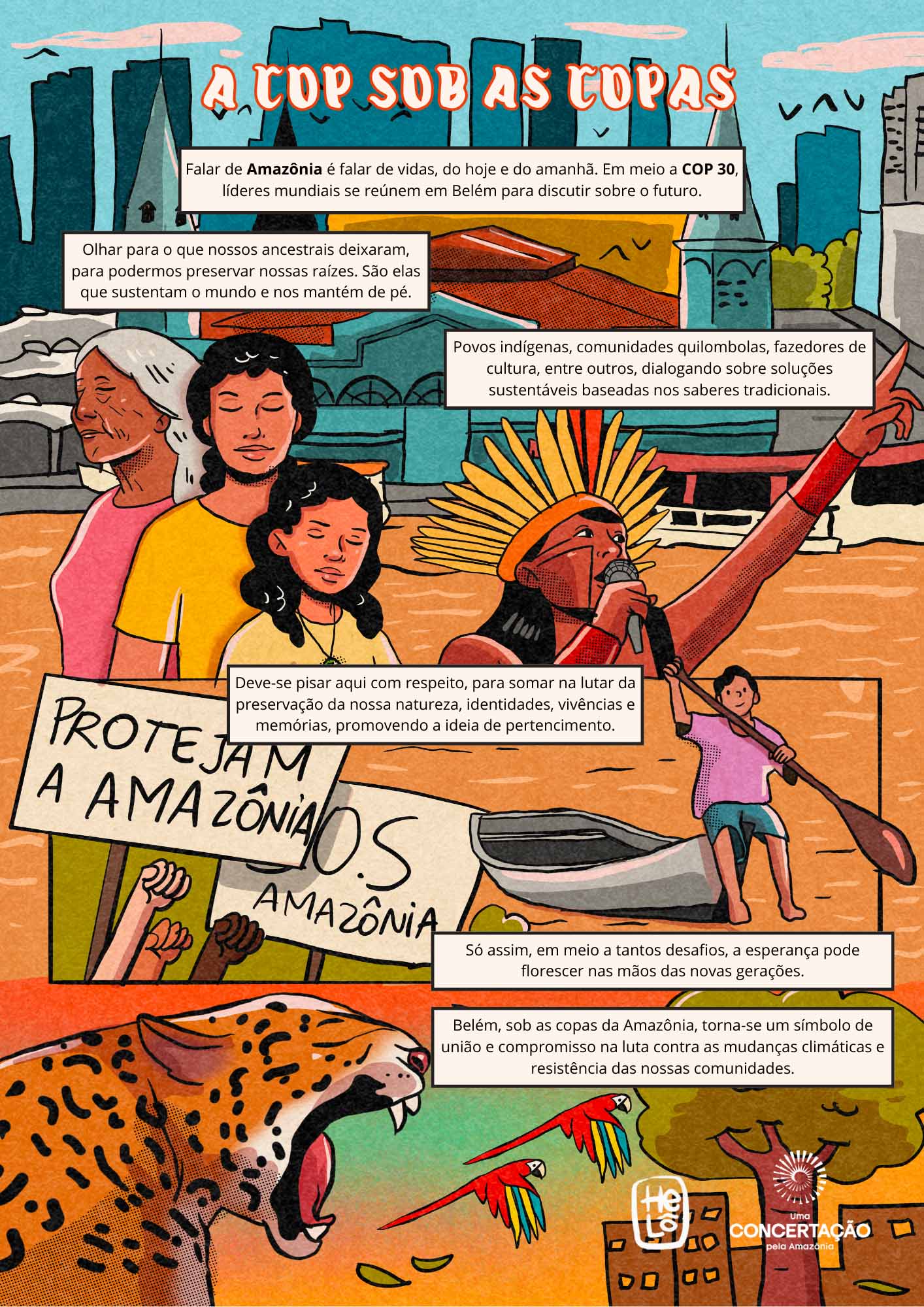
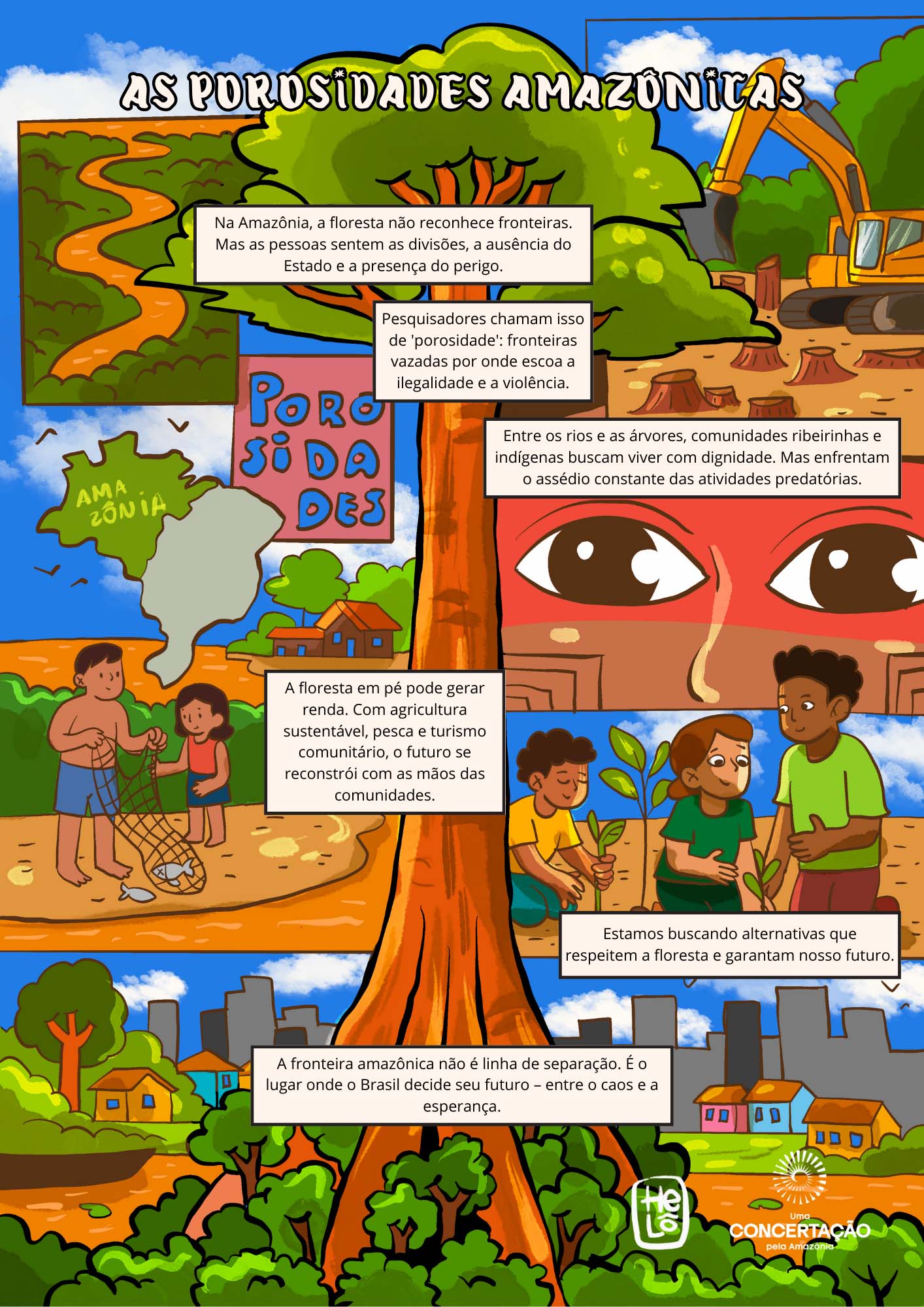
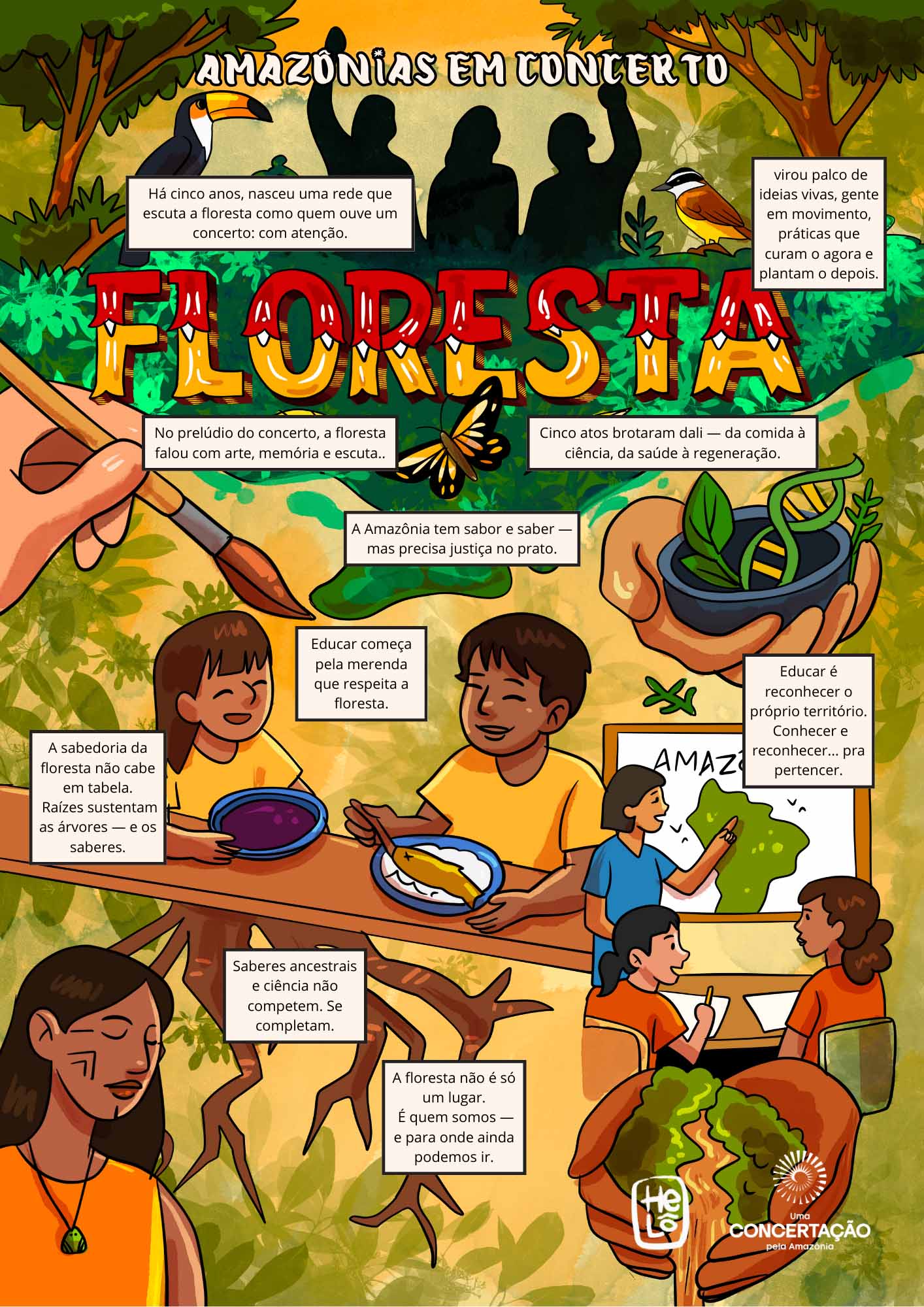
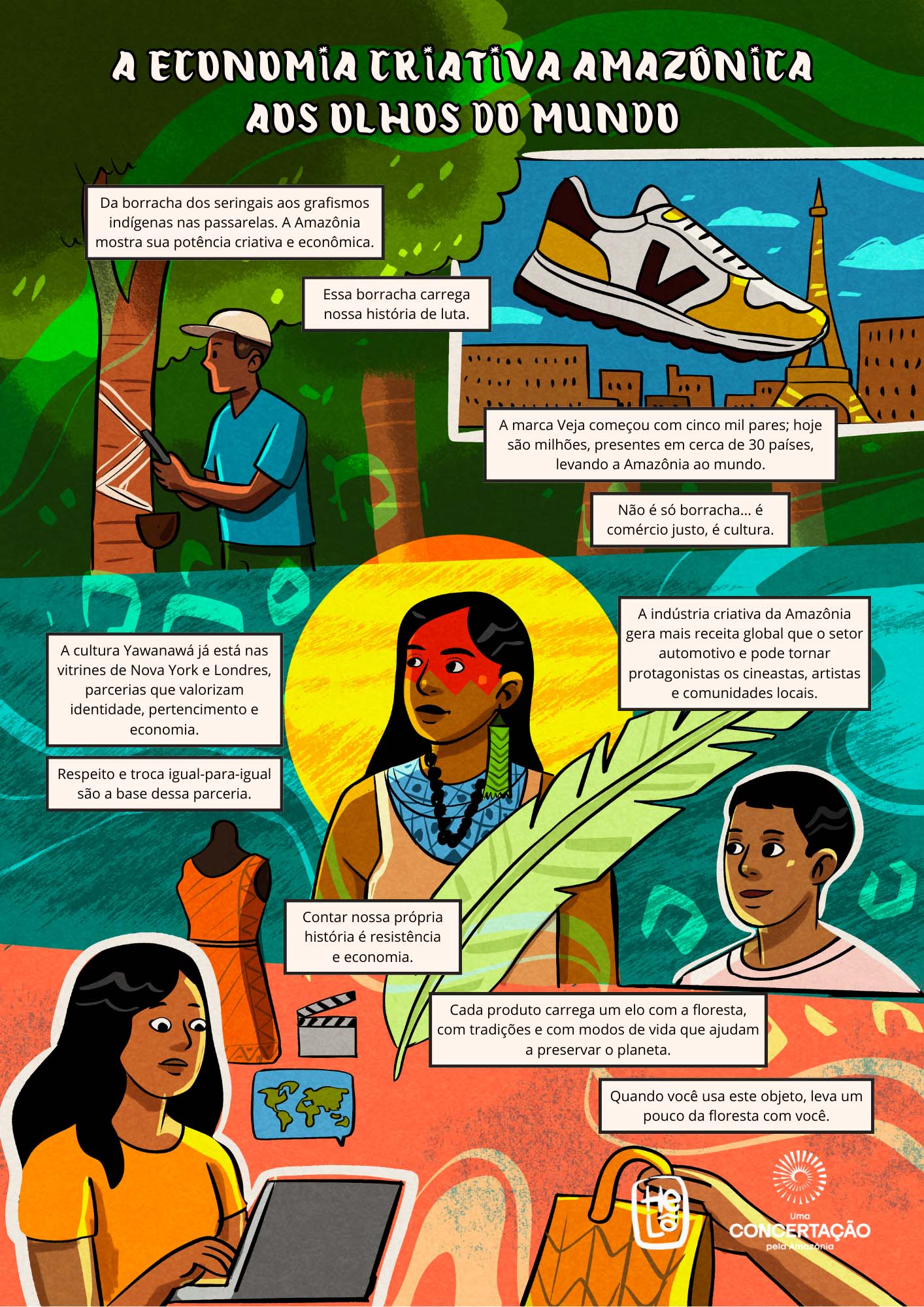
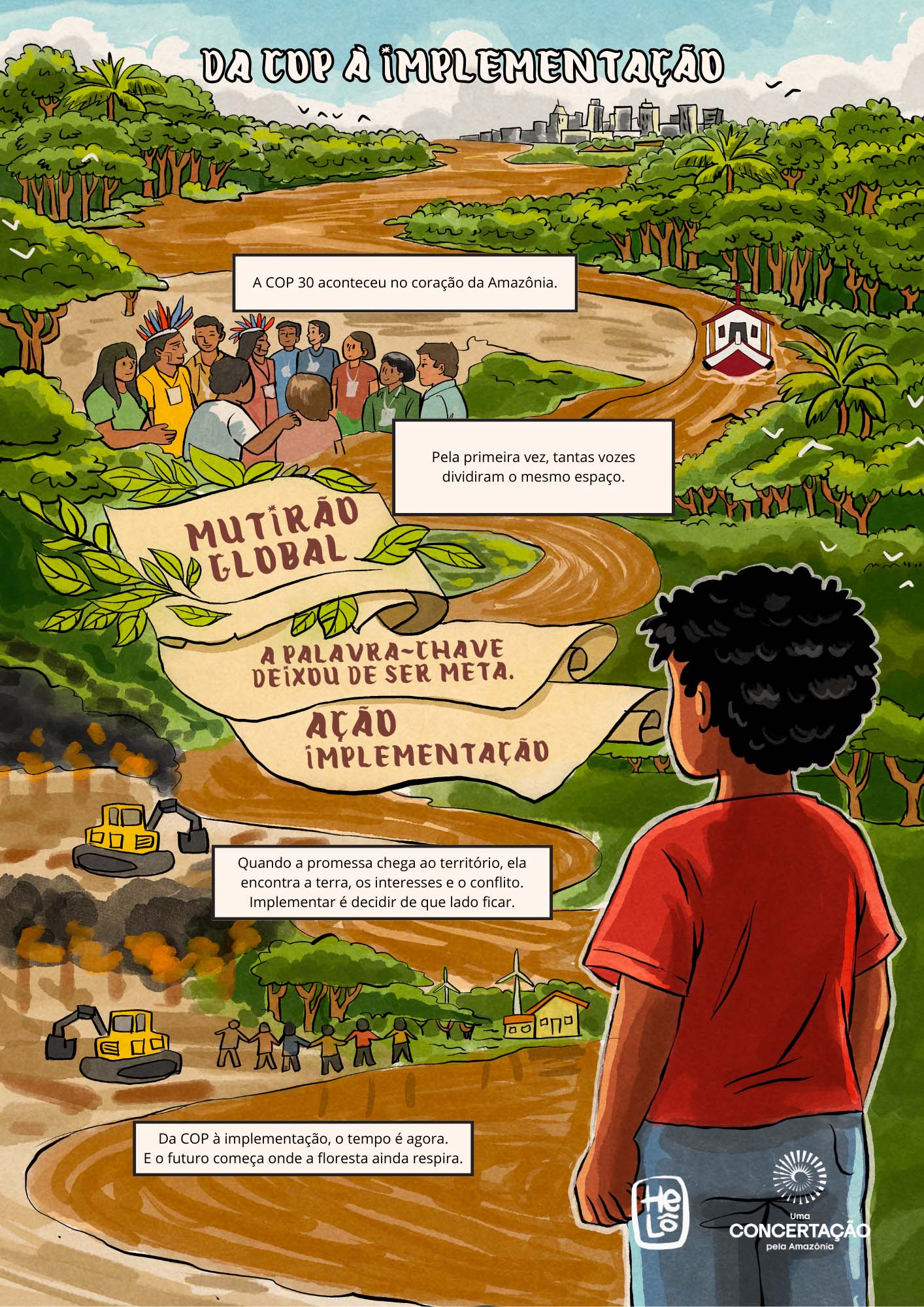
Plenary Sessions in Comics: Comic book illustrations translate debates, convergences, and collective paths built by the Concertação network.

Inspired by the culture, landscapes, and colors of her homeland, the artist Helô Rodrigues, from Pará — an illustrator, comic book artist, and designer — has created a series of illustrations in comic book style to represent the five plenary sessions of 2025.

The artworks transform the Network’s debates into visual narratives, giving aesthetic form to the themes, questions, and points of convergence that ran through each meeting. More than just graphic records, the stories offer a sensitive and accessible reading of the collective paths built by the Concertation to face the challenges of the Amazon.

With a recognized career in the field of independent comics, Helô Rodrigues engages with memory, territory, identity, and daily life in the Amazon. Her work spans editorial illustration, graphic design, and sequential storytelling, with contributions to independent publications, cultural projects, and educational initiatives. The artist is also part of networks and collectives of comic book artists in the Northern Region, contributing to the strengthening of the Amazonian comic book scene and to the expansion of the presence of female authors in the field of Brazilian comics.

TIMELINE

Meet the Amazonian artists who have already graced the Concertation´s digital channels.

Paulo Desana uses image as an affirmation of indigenous existence

April 2026
Filmmaker, visual artist and photographer Paulo Desana believes photography is a way of making visible abstract dimensions that are difficult to express in visual art: the knowledge, memory and permanence of indigenous peoples.

Miguel Penha Chiquitano does not paint landscapes, but the feeling of being in the forest

March 2026
Whoever stands before the large canvases signed by the artist, with their filtered light, deep colors, and deliberate absence of human or animal figures, receives an invitation to enter the forest and allow themselves to be enveloped by it

Yan Bentes invites one to envision possible futures for the Amazon

December 2025
Among rivers, memories and enchantments, the artist constructs a plural and affective Amazon, where ancestry inspires visions of the future that transcend the climate crisis

By painting sounds, PV Dias imagines new futures based on the urban music scene of the Amazon

September 2025

By painting sounds, PV Dias imagines new futures based on the urban music scene of the Amazon

Photography, video, digital art, augmented reality. Saturated and vibrant colors, pop aesthetics, references to Afrofuturism Cultural, aesthetic and political movement that manifests itself in various fields of the arts from a Black perspective. It uses science fiction and fantasy to create narratives of Black protagonism, celebrating their identity, ancestry and history. and the Caribbean and South American Amazons. These are central elements in the art of Paulo Victor Dias, PV Dias, an artist who will inspire our digital channels as of September

PV Dias brings the sound, visual and political pulse of the urban Amazon into his art. Inspired by the vibrant cultural scene of the outskirts of the city, his paintings visually convey the rhythms of tecnobrega—electronic beats that blend synthesizers with elements of regional Amazonian music.

Calypso, carimbó, forró, and zouk are portrayed in his work linked with a pop aesthetic and the Afrofuturist movement, in visual narratives that stem from a careful listening to the regional past and present.

Its strong connection with the effervescent nightlife scene inspires paintings that explore not only the rhythms, but the universe of the creative economy surrounding large-scale sound system parties: transportation and assembly of structures, decor, lighting, street vendors, and the exhaustion at the end of the events. Thus, the microcosm of Amazonian sound systems represents the appreciation of the aesthetics of celebrations and the Amazonian urban way of life beyond clichés.

PV Dias' artistic Amazon is little known to the rest of Brazil

PV considers the Amazon he grew up in his fundamental visual reference. He is from Belém and was raised between the capital city and Ananindeua, but he always visited inland Pará, where his family lives. His experience living in Rio de Janeiro changed the way he understood the region. “Living outside Pará sharpened my perception. Things that I previously considered normal, like the soundscape of Belém, now seem unique to me,” he says.

Contact with stereotypical views of his homeland prompted his desire to rewrite narratives, addressing the rhythms and colors of the outskirts. His works often associate the urban landscape with the economic dimension of behind the scenes of events, highlighting their social and cultural impact.

Its strong connection with the effervescent nightlife scene inspires paintings that explore not only the rhythms, but the universe of the creative economy surrounding large-scale sound system parties: transportation and assembly of structures, decor, lighting, street vendors, and the exhaustion at the end of the events. Fascinated by the visual impact of these events, PV seeks to show a different Amazon, which promotes gigantic celebrations every weekend, but is little known in the rest of Brazil.

The cultural pulse that drives the Amazonian creative economy

Sound systems democratize culture and leisure, but they also have a strong economic impact. They employ truck drivers, loaders, audio and lighting engineers, visual artists, DJs and street vendors. These production chains support thousands of people who breathe music, become professionals, and their financial activity represent an important source of income.

Alongside other artists, PV highlights the role of local collectives in strengthening the Amazonian creative economy, which is becoming more and more independent of major sponsors. “There is a cultural pulse inland,” he reports.“Cametá Town in the state of Pará, for instance, is bustling. What strengthens the scene is not the artist alone, but the collective, the small circuits, the support systems.” Thus, by combining documents, imaginary characters, and pop elements, he creates what he calls “visual performance plots” to narrate a living, dynamic territory.

The Amazon connected to the world

The free flow of tecnobrega aesthetics is the theme of painting “Quinze anos na aparelhagem/Quinceañera en Sound System” [Fifteen years in sound system] (2023). The work represents the cultural convergence between the Brazilian Amazon and other countries in the region, sometimes stronger than the territory's identification with other parts of the country, one of the aspects of daily life of which PV is mindful.
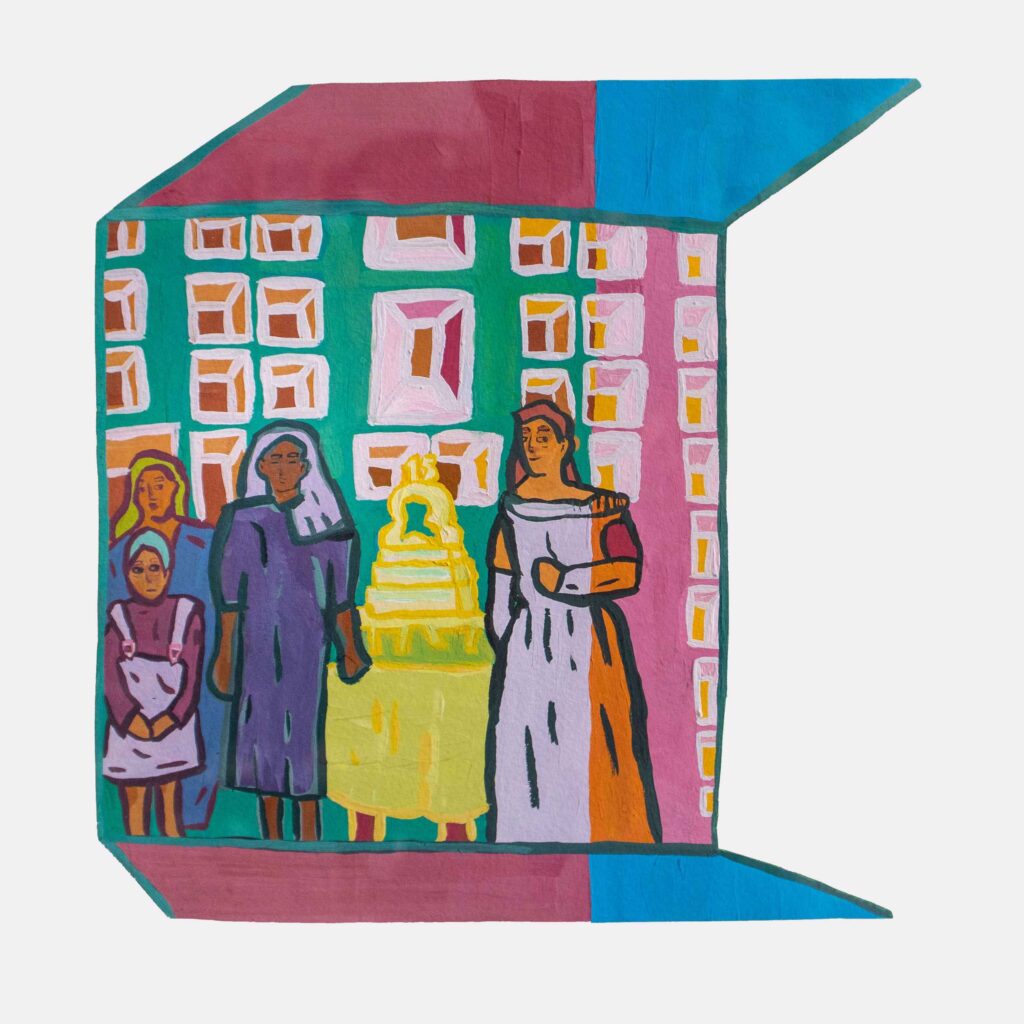
“Quinze anos na Aparelhagem. Quinceañera en Sound System” (2023)

This connection is also made clear by the presence of animals that are part of the decor and visual imagery of the sound system parties in Pará. An example is work “O Búfalo: A fauna futurista das aparelhagens" [The Buffalo: The futuristic fauna of the sound systems], which is part of a trilogy of large-scale paintings that also includes the crocodile and the eagle.

These figures, present at sound system parties, cross colonial borders and connect the Amazon to Caribbean and South American territories. According to PV, their inclusion in the parties' decor symbolizes how popular culture transcends geographical boundaries, leading sound, image and visual references beyond established borders.
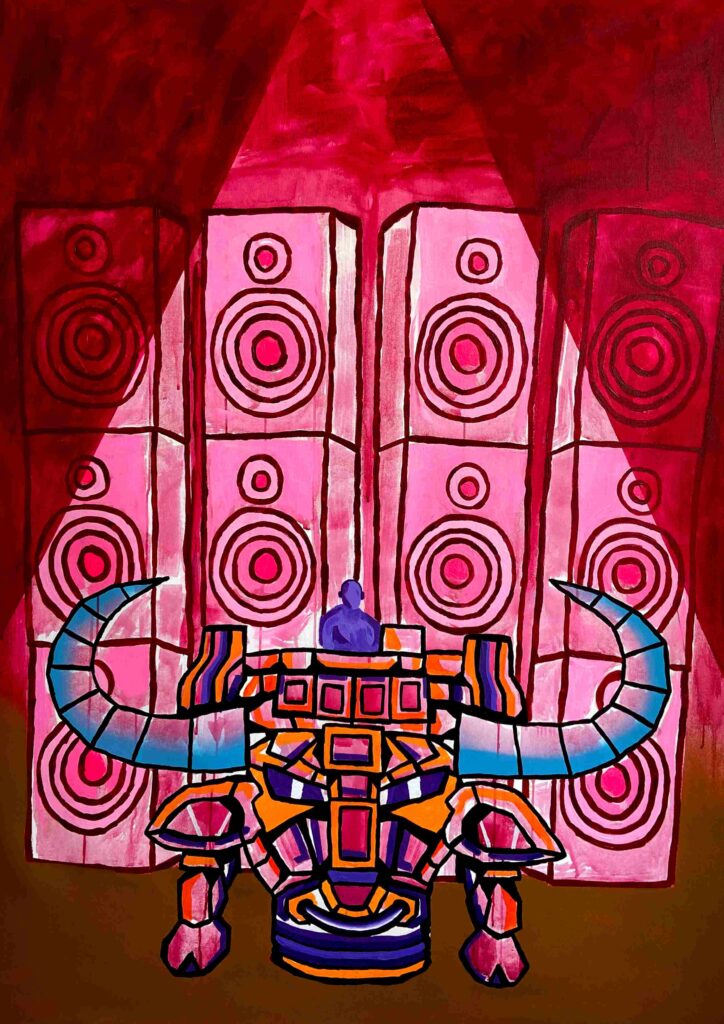
“O Búfalo. A Fauna Futurista das Aparelhagens” (2021)

In work “Luzes da noite FM” [Night lights FM} (2023), the artist portrays nightlife DJs in dialogue with the culture of the Colombian picós "picós" refers to the powerful sound systems that are an essential part of picotera culture, especially in cities like Cartagena and Barranquilla. These sound systems, decorated with colorful and cheerful designs, are used at parties and events to amplify the music, especially styles like champeta and other Afro-Caribbean rhythms. highlighting the international transit of sound system that unites Jamaica, Maranhão and Colombia.

“Luzes da Noite FM” (2023)

An artist who projects the future with an Amazonian accent


Afrofuturism, in its “anarchic and Amazonian” version, is also an essential element in PV Dias’ art. Its strong connection with the effervescent nightlife scene inspires paintings that explore not only the rhythms, but the universe of the creative economy surrounding large-scale sound system parties: transportation and assembly of structures, decor, lighting, street vendors, and the exhaustion at the end of the events.

It is in the projection of this future that not only his Black and urban roots converge, but also the rhythms, colors, scenes, technologies, traditions and stories that show a powerful and creative Amazon. “I am telling my story, which can be made up, just as other stories have been. (...) A future in which architectural, collaborative, visual and musical dynamics also come from an Amazonian perspective,” he explains.

And when art arises from the North, with its sparkle, beats and bodies in motion, it not only imagines new worlds, it opens up possibilities.

An Amazon at the forefront of modernity

PV Dias' art immortalizes an electronic and digital Amazon. The inspiration from tecnobrega sound systems challenges the stereotypical notion of an isolated, pre-modern Amazon. His work proves that the North is a creative power and innovation hub—a territory capable of influencing global aesthetics with colors, rhythms, and references to Black urbanity.

/* correção de hover dos ícones sociais */ html .elementor-48223 .elementor-element.elementor-element-4154965 .elementor-share-btn:hover { --e-share-buttons-secondary-color: var(--ucpa-color-2); } <!-- WORD LOREM -->.word { position: relative; color: var(--ucpa-color-main, #900); display: inline-flex !important; p { display: inline !important; } } .word a { cursor: pointer; text-decoration: underline; text-decoration-style: dotted; text-underline-offset: 3px; } .word__explanation { position: absolute; top: 100%; left: 0; width: 22rem; padding: 0.5rem 0.8rem 0.8rem; font-size: 0.9rem; background-color: color-mix(in lab, var(--ucpa-color-offwhite, #eee), white 30%); border-radius: 0 0.8rem 0.8rem 0.8rem; visibility: hidden; opacity: 0; transition: opacity 0.3s; z-index: 100000; pointer-events: none; box-shadow: 0 0 0.5rem rgba(0, 0, 0, 0.1); } :is(.word:hover, .word:focus, .word:focus-within) .word__explanation { visibility: visible; opacity: 1; pointer-events: all; } html .linha-das-artes-template-default figcaption { color: var(--ucpa-color-text, #333); } html .wp-block-image { padding-top: 0; }

Rafael Prado's works bear the colors, memories and resistance of the Amazons

June 2025

In July, the Rondônia-state artist's pieces will inspire the visual identity of our digital channels

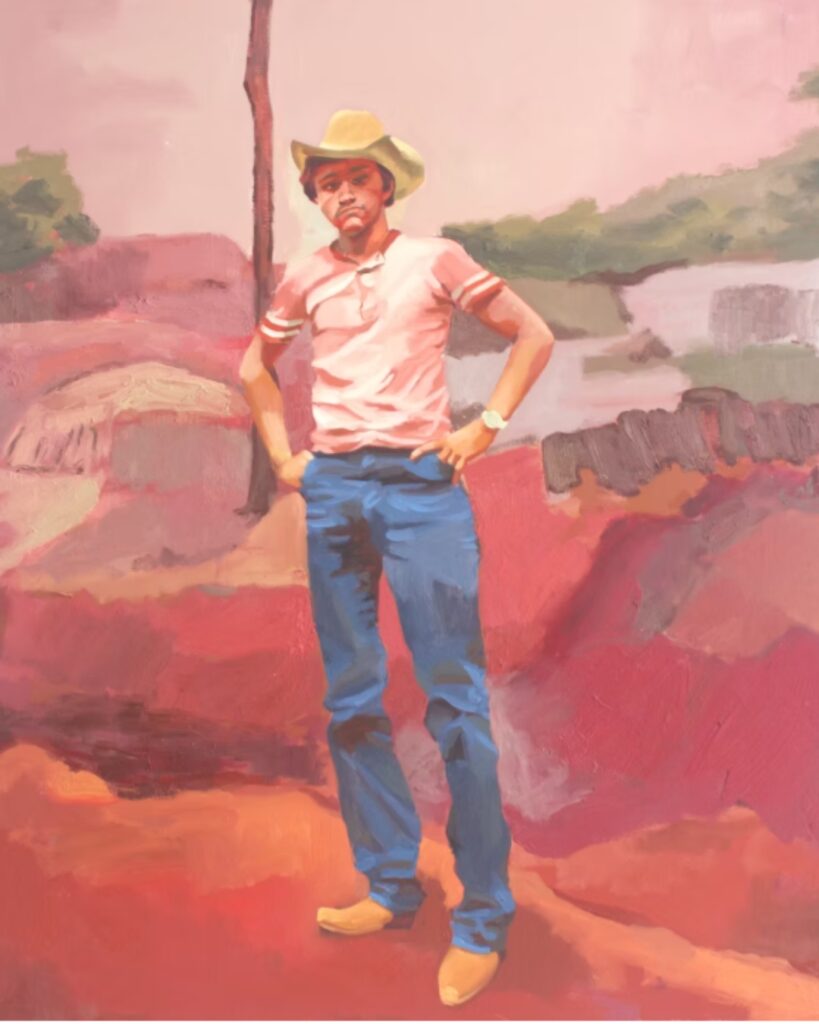
Boasting an authentic and striking style, Rafael Prado's work invites us to listen and immerse ourselves in the Amazon Rainforest and the stories of its population. His oil on canvas paintings offer us the opportunity to listen to and understand the people, territories and ways of life that have been silenced by violence, and remain invisible to the eyes of most Brazilians.

Characterized by thick brushstrokes, with a predominance of earthy and green tones, Rafael's art also depicts the environment in which these people live or have lived: the hot, moist, thick Amazonian atmosphere, where heat is intense and people perspire. 

In an interview with the Concertation, the Porto Velho city (RO) visual artist spoke of his approach to art as a way of amplifying different experiences and bringing worlds closer together.

Through art, what was once attempted to be silenced is yet immortalized

Rafael's artistic choices are inseparable from his life trajectory. Born to an indigenous mother from Rondônia, and father from the Brazilian Northeast, a migrant who left Ceará state in the 1980s to work in the Amazon mining industry, from an early age, Rafael's mother encouraged him to immerse himself in the world of arts, having maintained a close relationship with artists and experimented with multiple languages.  

In a family environment that is typical of the Amazons, he grew up hearing different stories about the occupation of the territory and the cycles of economic expansion that marked the history of Rondônia. In his view, interventions such as mining and the construction of large hydroelectric plants did not benefit the local people.

For him, despite the promises of wealth, these cycles brought much violence to the local communities. At the same time, they produced extraordinary human beings, who dedicated themselves to protecting the forest, its inhabitants and ways of life, but were silenced by dominant groups. It is the voices, dreams and struggles of these characters that Rafael portrays.

According to the artist, “painting is something that traditionally stands the test of time. It can last 500 years. Once you place a painting in a museum and preserve it, you can speak to other generations. Tell them what it was like, people's ways of thinking at a certain place and certain time.” When asked what stories he would like to tell himself and future generations, and how he would like to look into the past, the artist decided to talk “about the people who were silenced, literally erased, annihilated.”  

During our conversation, many were the times in which Rafael affirmed that the erasure of memories is part of the Amazon environment and it can be observed in multiple dimensions. For instance, he states that his family has indigenous roots, “but as it happens with many people in the Amazon, their history was silenced at home. This is erasure.”  

“When one's history is silenced, their existence is also erased. My resistance is to keep telling these stories, so that they are not forgotten” – Rafael Prado

For Rafael, art is delight and denunciation

Although he was initially interested in different artistic languages, painting is the art form in which Rafael found his path. It is through painting that he best expresses the voices of the Amazon as he imagines them.  

His art transitions between reality, dreams and the myths of the Amazon, and has as central elements magical realism, memory and social engagement. It tells stories from the perspectives of blacks, females and indigenous people, which have also been made invisible. “Painting these screaming absences is my way of giving voice to everything that has not yet been said about the Amazon,” he says.  

Rafael's symbolic and cultural universe combines these absences with hybrid characters composed of humans, nature and enchanted beings. “In the Amazon, human beings, animals, trees, rivers and stones are part of the same enchanted world. I call it the enchantments, and it is this language that I use when painting”, he says.

The way the artist tells these stories is intertwined with narrative forms that are very typical of the region, where folk stories such as that of the man who turns into a river dolphin, the woman who turns into a jaguar or the origin of cassava are quite frequently told.

In series “Os povos amazônicos não morrem, viram semente" [The Amazonian peoples do not die, they become seeds], the synthesis between forest and human being

In one of his most emblematic series, “Os povos amazônicos não morrem, viram semente”, Rafael combines nature and human being to tell the stories of murdered community leaders, portraying them as hybrid beings of the human race and the forest. By presenting the faithful combination of these universes, his art turns trajectories of struggle into symbols of resistance and permanence.

The series features people who had a fundamental purpose in life, for what they did, for the communities they protected. For the artist, these lives, rather than the circumstances of their deaths, are what one must remember.

This is the case with Zé Cláudio, who appears merged to a tree in Rafael's painting. His wife, Maria, is portrayed as a small agouti, an animal that buries seeds and thus ensures the reproduction of chestnut trees. The Brazil-nut extractivist couple fought against deforestation and were murdered in Pará in 2011:
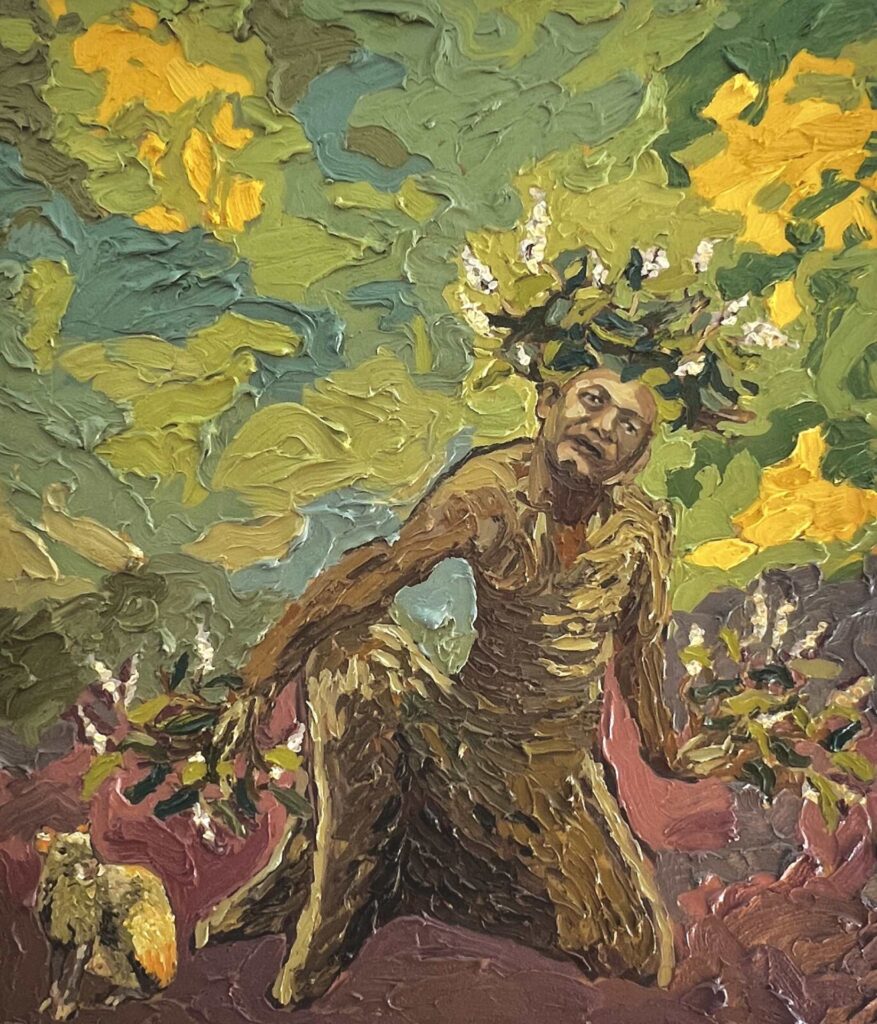
Zé Cláudio and Maria

The portrait that shows the saddened gaze of Chico Mendes, Pará-state advocate for the forest and extractive communities, murdered in 1988, is also paradigmatic:

Chico Mendes

Adelino Ramos, a rural leader from Rondônia linked to the Land Pastoral Commission and murdered in 2011, is portrayed as a tree, with his arms open:

Adelino Ramos

Synthesis of this collection of paintings, the following canvas shows major advocates for the forest in communion with it, and united in its protection:

From left to right: Paulo Paulino Guajajara (killed in 2019), Maria and Zé Claudio, Chico Mendes, Nicinha, of Movimento dos Atingidos por Barragens [Movement of People Affected by Dams] (killed in 2016), and Cacique Maroaga, Waimiri-Atroari leader (killed in 1974).

Between mining and El Dorado: this series presents the brutal reality of the extractive cycles of the Amazon

Rafael's critical view of the exploitation of the Amazon also straightforwardly appears in another one of his series, inspired by the folk story of Eldorado and mining, entitled “Eldorado: Moldura Criativa do Imaginário Amazônico” [Creative Frame of the Amazonian Imaginary]. Based on the mythical story of the city of gold, the artist draws an analogy between the promises of easy wealth that have spanned the centuries and the brutal reality of extractive cycles in the region.

Rubber, gold, timber, hydroelectric plants: according to Rafael, all of these cycles follow the same script of false promises of progress. Prosperity is always proclaimed, but never reaches those who live in the area. Instead, what is left are the scars of environmental and social destruction.

This set of paintings, which depicts mining workers, gave rise to exhibition “Órfãos do Eldorado”, [Orphans of Eldorado] held in São Paulo, in 2022. The artist wrote about the series on an Instagram post:

“In the middle of the Amazon rainforest, the heat and humidity are equally intense. Far from any village, men dig into the ground in search of gold. There, you can't hear the sound of animals, you can't hear the sound of the forest, only the deafening noise of the dredge engine running 24 hours a day.”

The following work was part of the exhibition and portrays a miner determined to find his long-cherished gold. However, all this determination produces is the desert around:
O Eldorado é aqui [Eldorado is here]

Raphael's art acts as a gateway to the Amazon

Rafael Prado's work is an example of art as a gateway to the Amazon region and to its (re)discovery. By painting the lives and sacrifices of real people, he reveals many realities and connects them with those who are unaware of their aspirations and struggles. Rafael calls upon the power of art so that erasure does not prosper and these heroes of everyday Amazonian life are not forgotten.

Much like us at the Concertation, Rafael believes in art and culture as paths to the (re)discovery and appreciation of the territory. They are essential allies in seeing the complexity of the multiple Amazons, not as something distant, but as a territory that pulsates and invites us to (re)discover it by means of the expressions and stories of those who inhabit it.

“I want my paintings to allow those who don’t know the Amazon to feel that this territory is alive, and that its stories matter.”

When asked about his dreams for the future, the artist's answer, yet so humble, also exposes his strong ambition. “I dream of more cultural centers in Rondônia, places where people can recognize themselves, create and appreciate their stories,” he explains.

Rita Huni Kuin defies visible and invisible boundaries through her art

April 2025
The artist crosses and challenges the boundaries that life presents to him, whatever they may be. His work inspires the visual identity of Concertação's digital channels.

Sibé Feliciano Lana or Kenhiporã - the child of dream drawings (1937-2020)

February 2025
The visual artist developed a fundamental work for the recording and preservation of the indigenous culture of the Upper Rio Negro, and, as of February, will inspire the visual identity of the Concertação's digital channels.

Making visible the invisible: the relentless pursuit of Éder Oliveira

December 2024
A hardened, joyless or constrained gaze, withered physique and unrevealed identity. Seen by society as outcasts, these are the individuals featured in Éder Oliveira's paintings. Using the crime pages of newspapers as raw material, the painter gives identity to the anonymous characters who are seen as criminals, even if not found guilty of any wrongdoing.

Rai Reis - The perfect photo is that I am yet to take

October 2024
Rai Reis sees himself much more as a professional photographer than an artist, but his body of work makes him the Mato Grosso photographer par excellence. And it is with this in mind that Rai, whose work inspires the visual identity of the Concertation's digital channels, mainly captures the landscapes of Mato Grosso and of the sertanejo (inlander), a character that is always highlighted in his work.

Carmézia Emiliano paints so as not to forget

August 2024
Becoming acquainted with Carmézia Emiliano's work is delving into the artist's ongoing effort to record every detail of the culture of her people, the Macuxi. Art whose every line, color, shape and scene reflects a choice, and is meticulously constructed in coherence with her “mantra”: “I paint so as not to forget my culture”.

Adriana Ramalho creates a universe of sensory experiences by amplifying microscopic details of nature

June 2024
Manaus-born artist will inspire the visual identity of the Concertation channels as of June 24th

Dacordobarro: an artist is born

April 2024
The techniques she uses are as diverse as her inspiration, including photography, licks, graffiti and collages. The self-portrait is present very strongly in her work, as a study of the image of her black body in the city's spaces.

Bonikta (Caio Aguiar)

March 2024
An artist from Pará who now “dresses” the Concertation’s digital channels, showcases his art rich in overlapping forms, times and spaces. Representative of the new generation of Amazonian urban art, he creates collective memories to imagine possible futures.

Laíza Ferreira

December 2023
Laíza Ferreira intertwines memory, fictions, territories and temporalities, and creates new possibilities of re-existence.

Through collage, the artist who inspires the visual identity of the Concertation's digital channels instigates imagery to reconnect with those who preceded her and fill the gaps left by the Amazonian cultural erasure.

Ueliton Santana

October 2023
A arte do acreano espelha o território amazônico, grandioso e por muitas vezes ignorado. Em seu processo de criação, Ueliton costuma substituir a tradicional tela de pintura por uma rede de descanso – objeto tão identitário da região. Essa rede serve como suporte para que ele represente visualmente as Amazônias e sua cultura entrelaçada com a grandeza da floresta.

Ronaldo Guedes

May 2023

Conceituado artista visual e ceramista marajoara, Ronaldo Guedes integra o coletivo de ceramistas e escultores Ateliê Arte Mangue Marajó, localizado no município de Soure, na Ilha do Marajó (PA).

Modelada a partir do barro retirado dos campos alagados da ilha, sua obra reafirma a cultura ancestral da região. Os pigmentos que garantem cor às peças vêm de rochas minerais como o argilito e o caulim.

Fotografadas por Pierre Azevedo, as peças de cerâmica marajoara de Ronaldo Guedes inspiram a identidade visual das redes da Concertação no período.

Genilson Guajajara

February 2023

Fotógrafo natural da aldeia Piçarra Preta, Terra Indígena Rio Pindaré (MA), Genilson teve seu primeiro contato com a fotografia aos 23 anos, quando participava de uma oficina de formação política promovida pela organização Justiça nos Trilhos, da Universidade Federal do Maranhão.

Seu trabalho tem como tema central sua comunidade, seus costumes e seu cotidiano. Se, de início, o artista fotografava com um celular, hoje usa equipamento profissional para contar histórias do povo Guajajara – e, a partir de fevereiro de 2023, suas fotografias ilustraram os diferentes canais virtuais da Concertação.

Hadna Abreu

October 2022

Formada pela Universidade Federal do Amazonas, desde 2009 a artista visual manauara atua no cenário cultural de sua cidade natal, onde recentemente assumiu a curadoria da galeria Manart. Suas principais áreas de atuação são ilustrações de livros, pintura em aquarela, escultura, arte urbana, exposições de arte e ensino em cursos livres.

Hadna desenvolveu uma série de aquarelas sobre sementes da Amazônia exclusivamente para a Concertação, obra que em outubro de 2022 passou a inspirar o layout dos canais digitais da rede.

Rogério Assis

August 2022

Paraense com mais de 30 anos de profissão, Rogério iniciou sua vida profissional documentando etnias indígenas para o Museu Emílio Goeldi, em Belém do Pará. Integrou, em 1989, a expedição oficial da Funai de primeiro contato com a etnia Zo’é, tendo publicado essa documentação em mídias nacionais e internacionais.

Participou de exposições em diversas cidades brasileiras, além de Cuba, Alemanha, Estados Unidos e África do Sul. Atualmente desenvolve projetos documentais na área socioambiental, ministra workshops sobre fotografia documental, além de colaborar com as ONGs Greenpeace e Instituto Socioambiental (ISA).

Em agosto de 2022, seu trabalho serviu de base para a identidade visual dos diferentes canais virtuais da Concertação.

Raonizar as Cidades

July 2022

Ação coletiva realizada no Dia Mundial do Meio Ambiente (5 de junho) em 2022, para homenagear o cacique Raoni como símbolo da luta e preservação da Amazônia e dos povos indígenas. Raoni Metuktire foi o único indígena brasileiro indicado ao prêmio Nobel da Paz até então.

Com participação de mais de 20 organizações da sociedade civil, o projeto que inspirou a identidade visual da Concertação em julho de 2022 envolveu a colagem de lambes de 6m² com a imagem do líder mebêngôkre em 50 cidades de todas as regiões do Brasil, além de projeções e murais.

Ciclos Para o Amanhã

May 2022

A exposição híbrida que esteve em cartaz em maio de 2022 na Manart Galeria (Manaus) e, virtualmente, no site da Concertação, também inspirou a identidade dos canais digitais da rede no período.


Com curadoria de Hadna Abreu e Anna Lôyde Abreu, a mostra buscou responder à pergunta “E como será nosso amanhã na Amazônia?”, trazendo a visão de 16 artistas da região que se dedicam e lutam pelo chão que habitam: Skarlati Kemblin, Rakel Caminha, Thaís Kokama, Otoni Mesquita, Gisele Alfaia, MIA, Buy Chaves, Rui Machado, Chermie Ferreira, Francimar Barbosa, Raiz, Alonso Jr., a dupla Curumiz, Turenko Beça e Antônio II.

Rakel Caminha

June 2022

She’s a Manauara artist. Her creations talk about social issues, ecological and pertinent to the female universe and is her sing art of the single Hutukara, from the Amazonian band Marambaya, which opened the plenary in which she participated. Hutukara means “the part of the sky from which the earth was born” and expresses a part of the worldview of the forest peoples. 

“Hutukara is like a body where everyone lives, there is no ‘outside’ – everything is exchange, and we need to exchange with nature. Likewise, the Amazon is a reflection of what are the people who live in it, the various interconnected cultures, while it is global”, explains the artist.

Karoline

April 2022

Karoline Barros has been drawing since forever and is an architect and urban planner graduated from FAU-USP. She works professionally in the transversal between arts and sciences, always guided by territories and their (r)existences. A native of Minas Gerais, she currently resides in Manaus-AM, working in the capital and interior of the state for the Executive Office of Science, Technology, and Innovation of Amazonas. Assumedly enchanted by the Brazilian north that she has immersed herself in, she designs for herself in an attempt to consolidate thoughts, knowledge, images, and projects that make up her professional and personal life.

RUI MACHADO

November 2020

Painter, composer and poet. It was the first artistic participation in the concertation dialogue space. “Participating in this meeting is an opportunity for Brazil to discover Brazil. I am Amazonian, I was born to an Amazonian mother of Portuguese descent, and Portuguese father. I’m in love with the Amazon and have always painted it long before it became a trend”. When asked about your view on The Amazon, the answer is simple: “Those who love, care”.

ELIAKIN RUFINO

December 2021

Born in Boa Vista, Roraima, Eliakin Rufino is a poet, singer, writer, philosophy professor, cultural producer and journalist. It is one of the members of the Roraimeira movement – an Amazonian cultural expression considered by social scientists as one of the greatest exponents in the construction of Roraimense identity. Eliakin is an artist of the word. “There’s a lot of talk about the place of speech. I, besides a talking place, I have what to talk of the place. The Amazon is my home, my origin and of my ancestors. There is not yet a listening to the Amazon and we continue to live this attempt to continue to colonize it”.

https://www.youtube.com/watch?v=l0VzAeRC9rU&feature=emb_rel_end

JULIE DORRICO

February 2021

PhD in Literature and Linguistics at PUCRS. Author of “Eu sou macuxi e outras histórias”, book published by Editora Caos e Letras, in 2019. Manages the @leiamulheresindigenas and the YouTube channel ” Literatura Indígena Contemporânea”. She strives to disseminate indigenous authorship literature in Brazil, as a researcher and curator. “Through indigenous literature, from the very enunciation of some names, we get to know some peoples and other indigenous languages. Literature also helps to know the territories.”

GUSTAVO CABOCO

March 2021

Wapichana Artist born in Curitiba, grew up listening to her mother’s stories about her family and the ancestral landscape of the wrought Roraimense. In his work, he reflects on the displacements of indigenous bodies, histories of his people and on the (re)connection with originating territories through art. 

In participating in the Concertation debate, he said, “May Mother Earth be recognized and declared a subject of rights, because for us, climate change is nothing more than a cry for help from earth.”

RAKEL CAMINHA

April 2021

She’s a Manauara artist. Her creations talk about social issues, ecological and pertinent to the female universe and is her sing art of the single Hutukara, from the Amazonian band Marambaya, which opened the plenary in which she participated. Hutukara means “the part of the sky from which the earth was born” and expresses a part of the worldview of the forest peoples. 

“Hutukara is like a body where everyone lives, there is no ‘outside’ – everything is exchange, and we need to exchange with nature. Likewise, the Amazon is a reflection of what are the people who live in it, the various interconnected cultures, while it is global”, explains the artist.

MARCELA BONFIM E A AMAZÔNIA NEGRA

May 2021

Marcela works as a photographer and visual artist in Porto Velho, Rondônia. A black woman, she dedicates herself to the project (Re)knowing the Black Amazon: black peoples, customs and influences in the forest, in the field of visual anthropology, which deals with the constitution and memory of the Brazilian black population in the Amazon region. 

The photographer explains that, before arriving in Rondônia in 2010, her imaginary about the Amazon was restricted to “wild nature, to the Indian, to nothing.” It was in the Amazon that she began a process of awareness about her own identity.

ERYK ROCHA E GABRIELA CARNEIRO DA CUNHA

June 2021

Directors and producers of the film “A Queda do Céu”, a work freely inspired by the eponymous book by shaman Davi Kopenawa Yanomami and French anthropologist Bruce Albert. The focus of the film, still in the editing phase, is the third part of the book, in which the shaman takes the place of the anthropologist and says what he thinks about the non-indigenous and their society. 

The lines captured by David Kopenawa and Salome Yanomami sound like diagnosis, alertness and invitation. So that we turn our attention to the diseases that are brought and are created from the predatory relationship with nature and to another possible way of proceeding.

BRUS RUBIO

June 2021

Painter, descendant of the original Huitoto and Bora peoples of the Peruvian Amazon. His art seeks to portray man’s connection with nature. His work, of cosmic joy, is inspired by his imaginary, history and ancestry. Some of his works were exhibited during the 5th plenary session of A Concertation for the Amazon.

PAULA SAMPAIO

July 2021

Born in Belo Horizonte, she went to the Amazon with her family when she was still a girl, and in 1982 chose to live and work in Belém (PA). During her degree in Social Communication (UFPa), she discovered photography and chose photojournalism to portray the daily life of workers, mostly migrants, who live on the margins of large exploitation projects and roads in the Amazon, mainly on the Belém-Brasília and Transamazon highways. In her journey, she also collects dreams and life stories of the people she meets on these roads.

RAKEL CAMINHA

September 2021

Rakel Caminha is an artist from Manaus, and her creations talk about social, ecological, and feminine issues. She was with us at the April plenary, and her artwork was again part of the September plenary. September plenary.

CHERMIE FERREIRA, KAMBÔ, PAULA SAMPAIO, RAKEL CAMINHA E RUI MACHADO

October 2021

Five artists contributed to the visual identity of the Concertation in October and November: CHERMIE FERREIRA, visual artist of Kokama descent seeking to incorporate her indigenous origin into her works; KAMBÔ, visual artist who combines traditional culture and technology, using immersion to portray the different Amazon regions; PAULA SAMPAIO, photojournalist who created Rotas, which portrays this Amazonian body, with a sensitive look on the daily lives of workers living on the margins of large exploration projects and on the roads of the Amazon; RAKEL CAMINHA, artist whose creations address social and ecological issues related to the female universe in the Amazon; and RUI MACHADO, painter, composer and poet, who sees the Concertation as an opportunity for Brazil to discover Brazil.

DENILSON BANIWA

December 2021

In December, the Concertation’s visual identity was based on series Colonial Fictions (or pretend I'm not here), by jaguar artist Denilson Baniwa, of Baniwa descent. Born in Rio Negro, inland Amazonas, Denilson's work is the expression of his experience as an Indigenous Being of present times, combining traditional and contemporary indigenous references and appropriating western icons to communicate the thought and struggle of native peoples in different media and languages, such as canvas, installations, digital media and performances.

RAIZ CAMPOS

February 2022

“My name is Rai, but people in the art scene call me Raiz. I'm a dreamer, but also a graffiti artist, and I use this technique to express my ideas”. This is how Raiz Campos, the artist who inspired the visual identity of the Concertation in February, introduces himself. Born in Bahia, Rai Campos Lucena moved to Vila Pitinga, in the Waimiri Atroari Reserve, inland Amazonas, with his father when he was three months old. He decided to become an artist when he saw a magazine featuring graffiti art, and hasn't stopped since that. His work has been showcased in several cities in Brazil, especially Manaus, where he studies visual arts at the Federal University of Amazonas. His art is fully inspired by the Amazon, a source of endless inspiration.

ANTÔNIO II

April 2022

At just 12 years of age, the Amazonian Antônio II is already seen as a huge artist. He started painting at the age of four, when he discovered the Parintins Festival universe and found his gift for drawing. Nature is one of the boy's main inspirations. According to him, his influences come from “nature, man's relationship with the Amazon, social issues, the Modern Art Week of 22, musical movements such as ‘tropicalismo’, and other musicians, singers and composers”. Using crayons, acrylic paint, oil and colored pencils in his creations, Antônio is the artist who inspired the Concertation networks' visual identity in April and May.