Among rivers, memories and enchantments, the artist constructs a plural and affective Amazon, where ancestry inspires visions of the future that transcend the climate crisis
Born in Juruti (PA) and residing in Manaus, visual artist, illustrator, and designer Yan Bentes transforms childhood memories into imagery that invite one to envision possible futures for the Amazon. Through art, he connects with his land and his ancestors, transforming this legacy into inspiration for the present and the future.
“Art was the path that I found to portray all I learned from my parents, my grandparents, and the people of my homeland,” says Yan. In his works, affection, mysticism, and ancestry intertwine to celebrate ways of life and strengthen memories that resist erasure.
Among rivers and mythical beings, Yan depicts an Amazon where the real and marvelous coexist. Fascinated by enchantment stories and “creatures of the deep” narrated by Zeneida Lima Zeneida Lima is a Brazilian pajé [shaman], environmentalist, and writer, author of book “O Mundo Místico dos Caruanas da Ilha do Marajó” [The Mystical World of the Caruanas of Marajó Island], which explores the mystical universe of the Caruanas, enchanted beings of local mythology, who live deep down into rivers and lakes. the artist incorporates into his work the mystery of the waters and the spiritual presence that inhabits the territory.
The hybrid figures he creates, part human, part nature, evoke the idea of seeing the world through the eyes of the forest and rivers, recognizing other forms of life and sensitivity. By means of his drawings and illustration, the artist explores paths through which he transforms everyday life in the Amazon into visual stories that affirm identity and belonging.
From the riverbanks to drawn lines
Yan’s interest in art began as he was still a child, watching his uncle Ednart draw allegories for Festribal, a festival that celebrates the Muirapinima and Munduruku indigenous cultures in Juruti. These early glimpses into the environment sparked the curiosity and fascination that usher his work today.
Only years later did he realize that he could make a living from art. When Yan moved to Manaus in search of education and work opportunities, computing was the first career option that came to his mind. During that time, he studied Management and Information Technology and, it was while working as an intern at the Amazonas Education Media Center that he first came across Graphic Design.
He soon became involved with such art, started showcasing his work online, and undertook an Art and Society specialization course to deepen his knowledge. However, it was only when invited by writer Jan Santos to illustrate work “O Livro do Rio: Iguaraguá” [The Book of the River: Iguaraguá] (2021) that Yan realized that “I could express myself through my illustrations, through my style”. Their work won the Manaus de Conexões Culturais Award [Manaus Cultural Connections Award] and, since then, the duo has published another book, “Rudá: Filho da terra e das estrelas” [Rudá: Son of the Earth and the Stars] (2023), which won the Thiago de Mello Award.
Alongside his editorial and artistic work, he is still at the Amazonas Education Media Center, now creating educational illustrations that connect school content to local reality. “It is rewarding to see these children recognize themselves in the pictures. I wish I had teaching material like this back in my day,” he said.
Today, like his uncle, he also creates illustrations and visual identities for major events, such as the Amazon Film Festival – Olhar do Norte, the Amazon Theater Festival (FTA), and the Amazon Literary Fair (FLAMA).
This work, focused on education and cultural appreciation, strengthened his purpose of representing the Amazon from within — with its faces, gestures, and ways of life — and of revealing, through art, the power of envisioning possible futures from one’s own roots.
His profound sense of connection to the territory and commitment to education is one reason why Yan was one of the artists invited by the Concertation to create two cards
for game Dixit Amazônias Dixit Amazônias is a special edition of the game, created by the Concertation in partnership with publisher Asmodee. It features cards illustrated by Amazonian artists, representing five views of the region: Conserved, Converted, In Transition, Urban and Waters.. Released in November 2025, Dixit’s special edition aims to be a tool for narrating the territory through sensitivity and listening. The game was distributed free of charge to local schools that take part in the Amazon Amazon Itineraries program Amazon Itineraries is a project of iungo and Reúna institutes with the Concertation, in partnership with BNDES, Hydro Sustainability Fund, Arapyaú Institute, Movimento Bem Maior, and sponsored by Vale., which has impacted 44,000 educators by means of teaching materials and training processes that promote the Amazon in Brazilian schools.
Relatable Amazon: identity and belonging
Yan’s work rejects clichés about the region. His art showcases a diverse Amazon, formed by indigenous peoples, quilombola communities, riverside dwellers, and urban populations who share intertwined ways of life. “We are not only about red macaws, water lilies or river dolphins.” These are important elements for him, but not the only ones to be remembered. “We have many Amazons,” the artists says.
“The river is our road, our path, our avenue. “It is how my parents and I still connect,” Yan affirms. By turning these experiences into imagery, he makes art a form of continuity: each drawn line is also a gesture of reverence for Amazonian memory and spirituality.
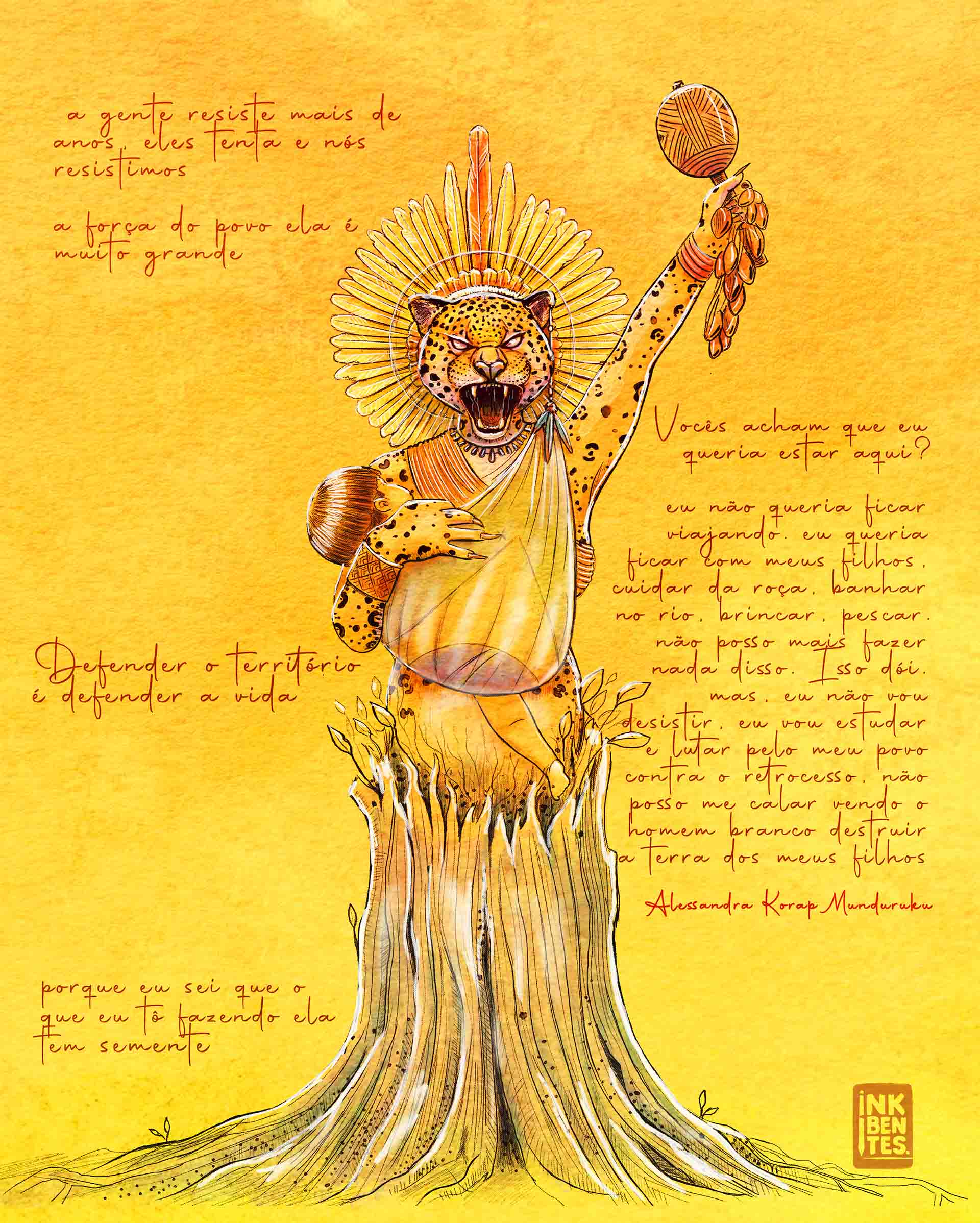
His perspective on daily life reveals a political and emotional dimension: drawing one’s own land is an act of personal assertion. Yan values everyday gestures and objects — the straw hand-fan, his grandmother’s herbs, the bowl passed down through generations — showcasing the wisdom that exists in simplicity and continuity between generations.
Each work, says the artist, is an invitation to reconnect with one’s origins. His compositions recreate family scenes, full of color and gentleness, as if insisting on reminding us that daily life in the Amazon is a space of creation and resistance. “We need to assert ourselves and celebrate our existence. Today, we experience forgetfulness, and it is crucial to reinforce how grand we are,” he says.
For Yan, COP30 represented an opportunity to overcome this invisibility: “I hope that they know that we exist, that we are doing a lot of great things.”
Imagining for existing: Amazonian art after COP30
When reflecting on what art can reveal in the climate discussion, Yan emphasizes the importance of recovering one’s capacity to imagine. Inspired by Aílton Krenak, he advocates the idea that “we must dream to postpone the end of the world. In a fast-paced world, people have lost the ability to dream, something essential when it comes to the future of the Amazon. When we speak of the climate crisis, we think about the end of the world. Art helps us dream of possible futures,” he says.
Thus, broadening perception, producing other imagery, and expanding the field of sensitivity towards a biome frequently presented through the prism of destruction is one of the central themes of his work. In the scenes he depicts, the forest, the rivers, and the people who inhabit them appear not as distant symbols, but as protagonists of a future that can (and must) be imagined from within the region itself.
For him, COP30 reinforced the importance of listening to those who live in that environment. And this is both a political and symbolic movement. “I hope that they know that we exist, that we are doing a lot of great things,” he says. The visibility achieved during and after the conference is not only a matter of individual recognition, but a call for more Amazonian artists to be given space, support, and the opportunity to envision other possible horizons for their communities.
In his work, imagination is not escapism. It is about insisting on continuity, affirming the power of Amazonian life, and challenging narratives of erasure. His visual compositions propose rifts in the hegemonic imagery of the region, reminding us that the Amazon produces culture, thought, aesthetics, and the future.
When life becomes imagery: works that tell stories
Yan Bentes’ illustrations are permeated by memories that, when shared, invite others to recognize themselves in these fragments of Amazonian life.
In Criancice [Childhood Play], for example, Yan revisits the afternoons when he and his friends would climb trees and jump into lake Jará, in Juruti. The picture of the child in freefall, surrounded by piranhas and dolphins, embodies courage, playfulness, and a connection to the river. In the foreground, hands hold an açaí bowl. These are the artist’s hands, portrayed by him, in a gesture that symbolizes offering and sharing: giving the public a memory that still has a pulse.
“Everything I do, I do with my own hands,” says Yan. Here, they become a bridge between the past and the present.

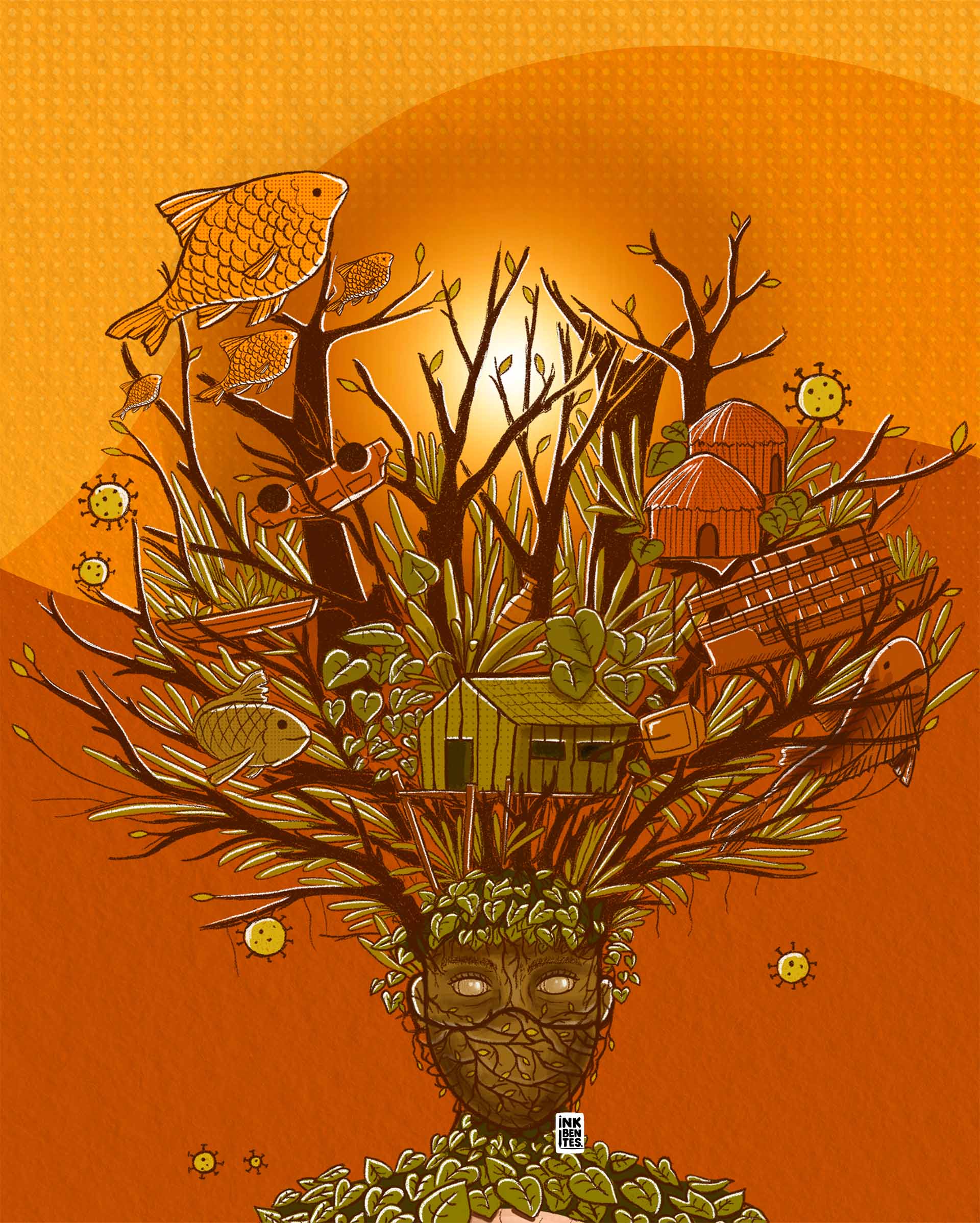
Work Natureza e a Pandemia [Nature and the Pandemic] portrays the forest’s return while people remained at home. Mother Nature expands over houses, canoes, and everyday objects, as if reclaiming the space that was interrupted by the urban routine. Earthy and warm tones reinforce the Amazonian heat, even amidst the silence of the streets. “I wanted to bring in this perspective of how nature was taking over everything again,” he explains.
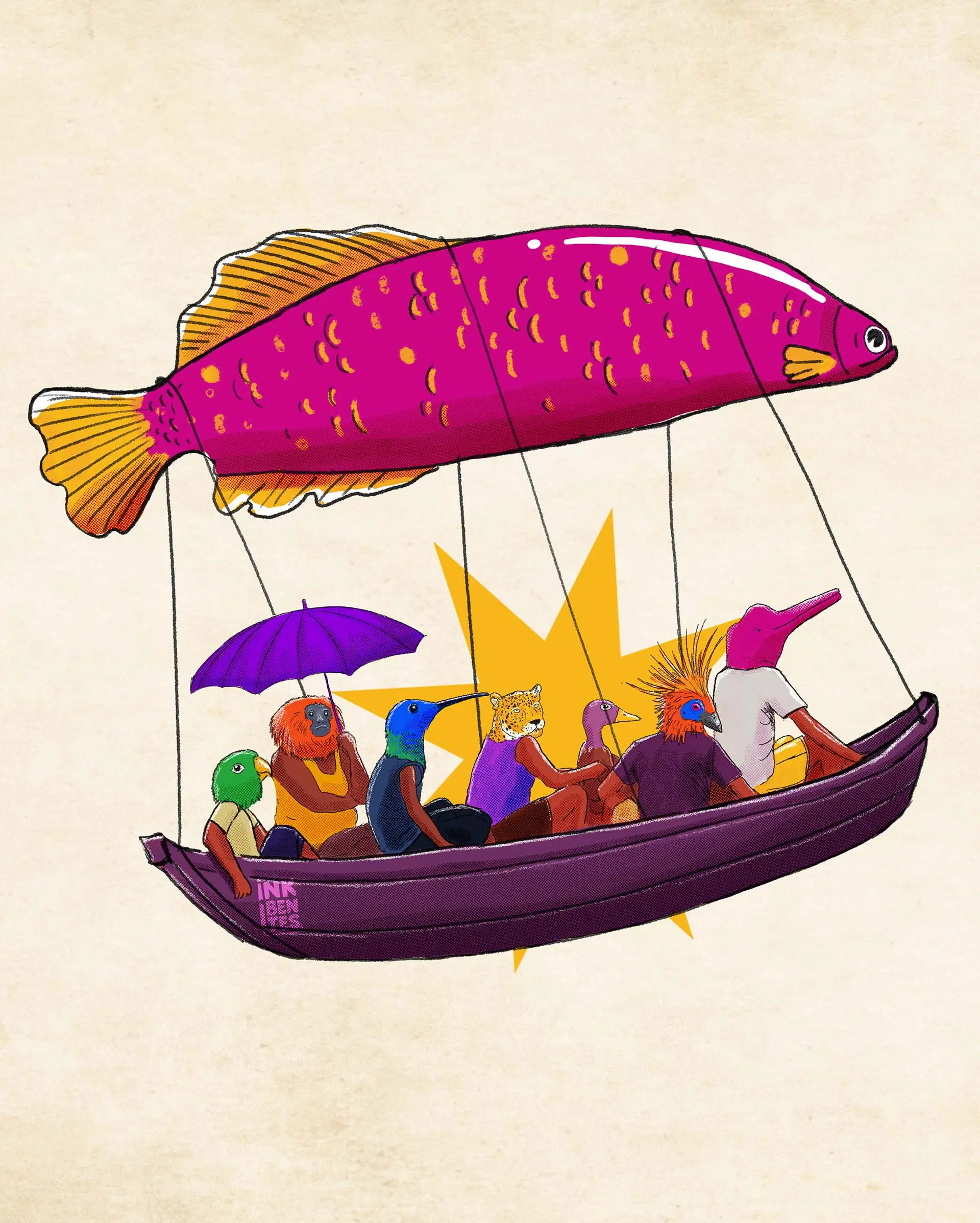
Balão Pirarucu [Pirarucu Balloon] (2024)
For the Amazon Theater Festival, Yan created a fantastic being: a pirarucu fish that transforms into a balloon and carries people and animals of different origins, as a metaphor for the collective dimension of Amazonian cultures. Combining river dolphin, cock of the rock, parakeet, golden lion tamarin, and other figures, this work celebrates the cultural exchange between Brazilian states and the presence of artists from several regions.
“I wanted to depict an insane Amazon, as insane as theater,” the artist jokes.
With Yan, we can see an Amazon that imagines, creates and continues
Yan Bentes’ work reaffirms the importance of recognizing those who live and create in the Amazons as protagonists of the narratives about their own home. His illustrations show that imagining the future requires sensitivity to listen to knowledge, memories, and experiences that are not always included in technical discussions, but that sustain life in the region.
By sharing these stories, Yan broadens our understanding of Amazonian diversity and inspires new interpretations of the present and the future. His art reminds us that preserving and transforming the Amazons involves valuing people, cosmologies, and the ability to imagine worlds. An essential call for any agenda committed to the territory.