
In July, the Rondônia-state artist’s pieces will inspire the visual identity of our digital channels
Boasting an authentic and striking style, Rafael Prado’s work invites us to listen and immerse ourselves in the Amazon Rainforest and the stories of its population. His oil on canvas paintings offer us the opportunity to listen to and understand the people, territories and ways of life that have been silenced by violence, and remain invisible to the eyes of most Brazilians.
Characterized by thick brushstrokes, with a predominance of earthy and green tones, Rafael’s art also depicts the environment in which these people live or have lived: the hot, moist, thick Amazonian atmosphere, where heat is intense and people perspire.
In an interview with the Concertation, the Porto Velho city (RO) visual artist spoke of his approach to art as a way of amplifying different experiences and bringing worlds closer together.
Through art, what was once attempted to be silenced is yet immortalized
Rafael’s artistic choices are inseparable from his life trajectory. Born to an indigenous mother from Rondônia, and father from the Brazilian Northeast, a migrant who left Ceará state in the 1980s to work in the Amazon mining industry, from an early age, Rafael’s mother encouraged him to immerse himself in the world of arts, having maintained a close relationship with artists and experimented with multiple languages.
In a family environment that is typical of the Amazons, he grew up hearing different stories about the occupation of the territory and the cycles of economic expansion that marked the history of Rondônia. In his view, interventions such as mining and the construction of large hydroelectric plants did not benefit the local people.
For him, despite the promises of wealth, these cycles brought much violence to the local communities. At the same time, they produced extraordinary human beings, who dedicated themselves to protecting the forest, its inhabitants and ways of life, but were silenced by dominant groups. It is the voices, dreams and struggles of these characters that Rafael portrays.
According to the artist, “painting is something that traditionally stands the test of time. It can last 500 years. Once you place a painting in a museum and preserve it, you can speak to other generations. Tell them what it was like, people’s ways of thinking at a certain place and certain time.” When asked what stories he would like to tell himself and future generations, and how he would like to look into the past, the artist decided to talk “about the people who were silenced, literally erased, annihilated.”
During our conversation, many were the times in which Rafael affirmed that the erasure of memories is part of the Amazon environment and it can be observed in multiple dimensions. For instance, he states that his family has indigenous roots, “but as it happens with many people in the Amazon, their history was silenced at home. This is erasure.”
“When one’s history is silenced, their existence is also erased. My resistance is to keep telling these stories, so that they are not forgotten” – Rafael Prado
For Rafael, art is delight and denunciation
Although he was initially interested in different artistic languages, painting is the art form in which Rafael found his path. It is through painting that he best expresses the voices of the Amazon as he imagines them.
His art transitions between reality, dreams and the myths of the Amazon, and has as central elements magical realism, memory and social engagement. It tells stories from the perspectives of blacks, females and indigenous people, which have also been made invisible. “Painting these screaming absences is my way of giving voice to everything that has not yet been said about the Amazon,” he says.
Rafael’s symbolic and cultural universe combines these absences with hybrid characters composed of humans, nature and enchanted beings. “In the Amazon, human beings, animals, trees, rivers and stones are part of the same enchanted world. I call it the enchantments, and it is this language that I use when painting”, he says.
The way the artist tells these stories is intertwined with narrative forms that are very typical of the region, where folk stories such as that of the man who turns into a river dolphin, the woman who turns into a jaguar or the origin of cassava are quite frequently told.
In series “Os povos amazônicos não morrem, viram semente” [The Amazonian peoples do not die, they become seeds], the synthesis between forest and human being
In one of his most emblematic series, “Os povos amazônicos não morrem, viram semente”, Rafael combines nature and human being to tell the stories of murdered community leaders, portraying them as hybrid beings of the human race and the forest. By presenting the faithful combination of these universes, his art turns trajectories of struggle into symbols of resistance and permanence.
The series features people who had a fundamental purpose in life, for what they did, for the communities they protected. For the artist, these lives, rather than the circumstances of their deaths, are what one must remember.
This is the case with Zé Cláudio, who appears merged to a tree in Rafael’s painting. His wife, Maria, is portrayed as a small agouti, an animal that buries seeds and thus ensures the reproduction of chestnut trees. The Brazil-nut extractivist couple fought against deforestation and were murdered in Pará in 2011:
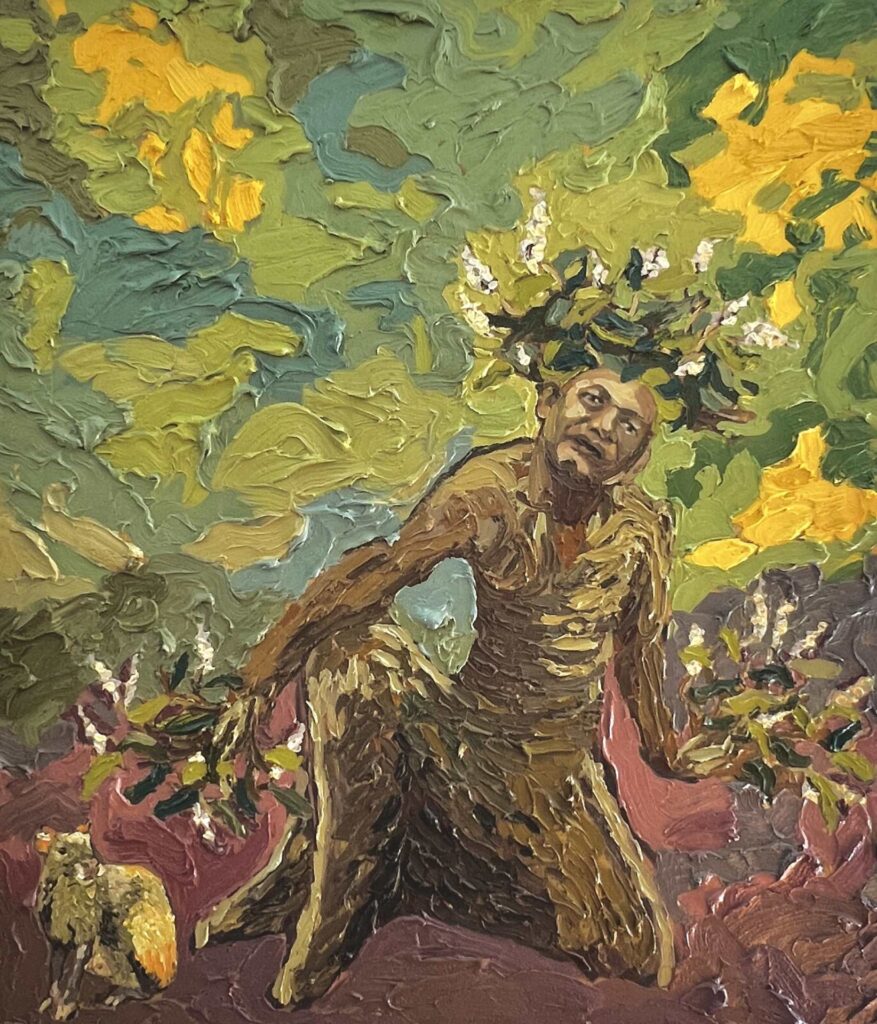
The portrait that shows the saddened gaze of Chico Mendes, Pará-state advocate for the forest and extractive communities, murdered in 1988, is also paradigmatic:

Adelino Ramos, a rural leader from Rondônia linked to the Land Pastoral Commission and murdered in 2011, is portrayed as a tree, with his arms open:

Synthesis of this collection of paintings, the following canvas shows major advocates for the forest in communion with it, and united in its protection:

Between mining and El Dorado: this series presents the brutal reality of the extractive cycles of the Amazon
Rafael’s critical view of the exploitation of the Amazon also straightforwardly appears in another one of his series, inspired by the folk story of Eldorado and mining, entitled “Eldorado: Moldura Criativa do Imaginário Amazônico” [Creative Frame of the Amazonian Imaginary]. Based on the mythical story of the city of gold, the artist draws an analogy between the promises of easy wealth that have spanned the centuries and the brutal reality of extractive cycles in the region.
Rubber, gold, timber, hydroelectric plants: according to Rafael, all of these cycles follow the same script of false promises of progress. Prosperity is always proclaimed, but never reaches those who live in the area. Instead, what is left are the scars of environmental and social destruction.
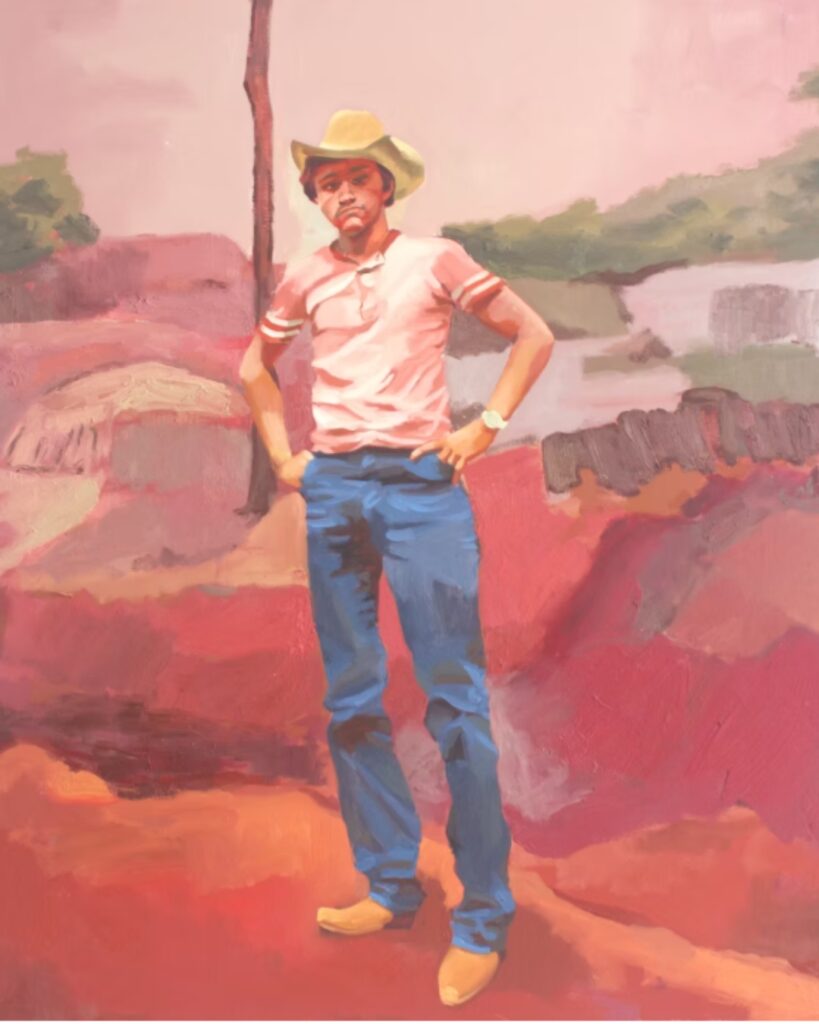
This set of paintings, which depicts mining workers, gave rise to exhibition “Órfãos do Eldorado”, [Orphans of Eldorado] held in São Paulo, in 2022. The artist wrote about the series on an Instagram post:
“In the middle of the Amazon rainforest, the heat and humidity are equally intense. Far from any village, men dig into the ground in search of gold. There, you can’t hear the sound of animals, you can’t hear the sound of the forest, only the deafening noise of the dredge engine running 24 hours a day.”
The following work was part of the exhibition and portrays a miner determined to find his long-cherished gold. However, all this determination produces is the desert around:
Raphael’s art acts as a gateway to the Amazon
Rafael Prado’s work is an example of art as a gateway to the Amazon region and to its (re)discovery. By painting the lives and sacrifices of real people, he reveals many realities and connects them with those who are unaware of their aspirations and struggles. Rafael calls upon the power of art so that erasure does not prosper and these heroes of everyday Amazonian life are not forgotten.
Much like us at the Concertation, Rafael believes in art and culture as paths to the (re)discovery and appreciation of the territory. They are essential allies in seeing the complexity of the multiple Amazons, not as something distant, but as a territory that pulsates and invites us to (re)discover it by means of the expressions and stories of those who inhabit it.
“I want my paintings to allow those who don’t know the Amazon to feel that this territory is alive, and that its stories matter.”
When asked about his dreams for the future, the artist’s answer, yet so humble, also exposes his strong ambition. “I dream of more cultural centers in Rondônia, places where people can recognize themselves, create and appreciate their stories,” he explains.