
Whoever stands before the large canvases signed by the artist, with their filtered light, deep colors, and deliberate absence of human or animal figures, receives an invitation to enter the forest and allow themselves to be enveloped by it
In the paintings of Miguel Penha Chiquitano (Cuiabá, MT, 1961), landscape is transformed into experience. He does not portray segments of the natural world, but rather a pictorial translation of lived experience. Drifting through his works is like crossing a dense forest, where orientation dissolves and time seems to stand still. This is not a casual choice. He expresses his understanding of the forest as a living and autonomous presence.
In an interview with the Concertation, Miguel recalls his career and discusses “new naturalism,” a concept he uses to define his art practice, which departs from both the documentary recording and romantic idealization of nature.
The forest is a living language, not a backdrop
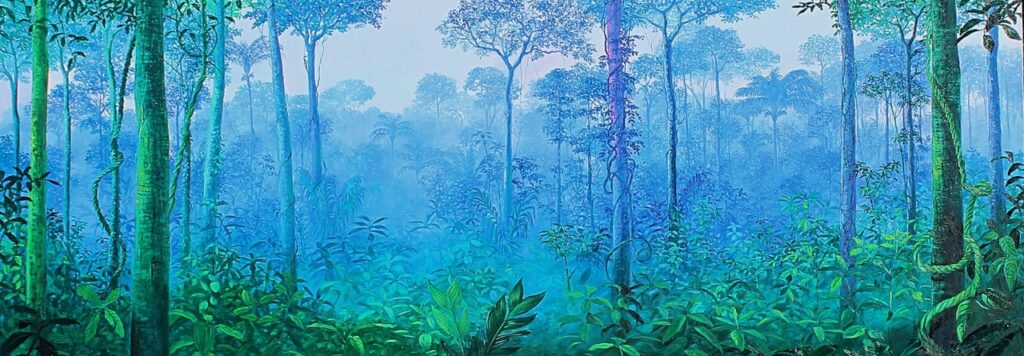
The Amazon, Cerrado, and Pantanal biomes do not appear in his works as recognizable settings. Far from being merely illustrative elements, vines, roots, palm trees, leaves, water, and mist function as signs laden with memory and sensitivity. These are real and identifiable species, but the scenes are a product of his imagination.
Sometimes, Miguel brings together, on the same canvas, plants that do not exist in the same territory. This choice breaks with geographical logic and opens up space for another form of organization, based on experience gained over decades of coexisting with diverse landscapes.
“The species are real, native, but the landscape is a product of my imagination. I create based on the feeling that that element brings me”, Miguel says.
The result is forests built from the overlapping of memories, walks and affections, which cease to be objects of representation and begin to operate as a language. They speak through color, light, and the density of shapes, activating a memory in viewers that is not always individual and can connect with an ancestral dimension.
Guaricanga, caranaí, ubim: one palm tree, many territories
One example is the guaricanga palm, also known as caranaí or ubim, which is present in both the Atlantic Forest and the Amazon Rainforest and is a recurring element in his works. His choice is not only botanical, but also an emotional and cultural one. “It appears in various places and has many names. I like it because it carries history,” says the artist.
Miguel learned of the use of this palm tree in indigenous villages and traditional communities, where its leaves are used for roofing houses. When dried, they acquire a strong golden hue that reflects light. By crossing biomes and cultures, the guaricanga synthesizes one of the main gestures of his paintings: articulating species in imagined landscapes, in which memory, experience, and ancestry overlap. The palm tree can be seen in several of his works, such as A Floresta e seus mistérios [The Forest and its Mysteries]:
From territory to studio, a journey that spans beyond visual experience
Miguel begins his creative process far from painting. Walking through the three biomes, observing the incidence of light, identifying species, feeling the soil moisture and the ambient temperature are fundamental steps in his work. At times, he creates paintings based on sketches or photographs. At other times, he only carries in his mind the memory of the experience.
In the studio, landscape is transformed into painting. The memory of sensations materializes into images built intuitively, with no strict planning. With rare exceptions, the intention is not to portray a place exactly as it is, but rather to recreate the energy that space produces.
For the artist, both nature and painting provide personal balance. Painting is a form of internal reorganization, an attention and listening exercise that is also offered to others. “Nature centers me, and so does painting.” It is where I am at my best”, he says.
In Miguel’s paintings, scale and color are pathways to sensory immersion
The frequent use of large canvases, some measuring up to 4 meters in width, amplifies the sensory impact of the paintings and requires physical movement from those who view them, according to Miguel. The scale prevents a comprehensive view and forces the eye to scan the surface, as if walking through an actual landscape.
It is no coincidence that color is one of the main instruments in this creation. The paintings result from applying paint in multiple layers, with intense chromatic experimentation and no use of black. The light that shines through the forest is not drawn, it arises from the relationships between tones.
Depth and contrast emerge from the mix of colors, in a conscious decision to avoid easy outlines or immediate effects. Regarding this choice, the artist says: “”black is quite appealing. I want to achieve light and contrast in another way, with no such shortcut”.
The absence of human and animal figures reinforces this logic. By avoiding points of direct identification, Miguel shifts the center stage to the forest itself. No action or presence organizes the space; only plant matter in its density, affirming the forest as a subject.
In painting Igarapé, for example, the artist brings together Amazonian species such as the kapok tree and the mariri vine (used to prepare Ayahuasca), depicting a stream that does not correspond to a specific territory. “The species are real, but this place does not exist. I create the landscape myself”, he explains.
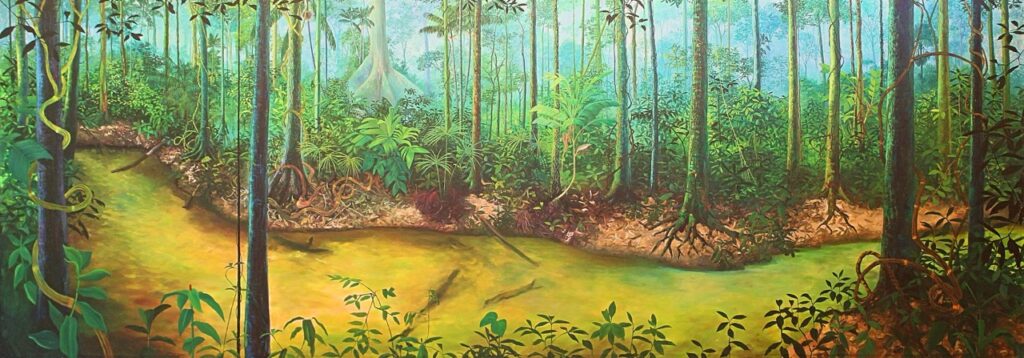
Here, the forest is neither a backdrop nor a faithful representation: it presents itself as a living, dense, and pulsating organism that envelopes the observer.
Indigenous roots in building his perception
This connection to remembered, albeit imaginary, forest landscapes has deep roots. Miguel was born on the banks of the Cuiabá River (MT), son to a Chiquitano Indigenous people who inhabit the border region between western Mato Grosso and eastern Bolivia. father and a Bororo Indigenous people also native to the border region between Mato Grosso and Bolivia, who also occupy areas in Goiás. mother. Since childhood, he lived in direct contact with the land, rivers, and plants, learning to recognize species, their uses, and cycles.
Indigenous memory permeates his work with practice: in his attention to detail of the flora, respect for natural rhythms and understanding of the forest as a living being. The experience gained throughout life manifests itself less as discourse and more as practice. “Nature is our mother. It is she who provides everything for us”, he explains.
A self-taught artist, he built his career outside formal academic training, seeking focused technical knowledge to ensure material autonomy and durability for his works. This training contributed to free practice, guided by observation and time.
‘New naturalism’ and the ethics of painting
When Miguel defines his work as “new naturalism,” he is not proposing an academic redemption or a formal update of its codes. The term expresses an ethical stance towards nature and artistic creation itself. It is about recognizing the forest as a living system that is under transformation and building a language that engages with this vitality.
The artist does not seek optical fidelity, but fidelity to sensation. “I use technique to ensure the quality of my work, but painting is an experience, not a reproduction”, he comments.
Thus, by rejecting literal representation and relying on imagination and memory as forms of knowledge, he places painting as a space of mediation between experience, territory, and the world.
The forest needs respect and regeneration to regain its presence
Miguel’s work also challenges the imagery of environmental devastation, which associates these territories with exploitation, scarcity, and collapse. By depicting dense and balanced forests, his paintings affirm the regenerative power of the forest.
For the artist, the forest does not need to be protected by abstract discourses, but by respect for its capacity to regenerate. “If you wish to protect the forest, leave it alone. It regenerates on its own”, he emphasizes. Nonetheless, he recognizes the urgency of restoring degraded areas, springs, and riverbanks. “Recovery is hard work. You have to show up, break a sweat and plant”, he explains.
By showcasing what still exists, his work invites one into careful observation, care, and reconnection. Instead of imposing answers, it creates a space for listening. A space where the forest ceases to be a landscape and becomes presence again.
Forest as an experience
Two works synthesize distinct gestures in his painting.
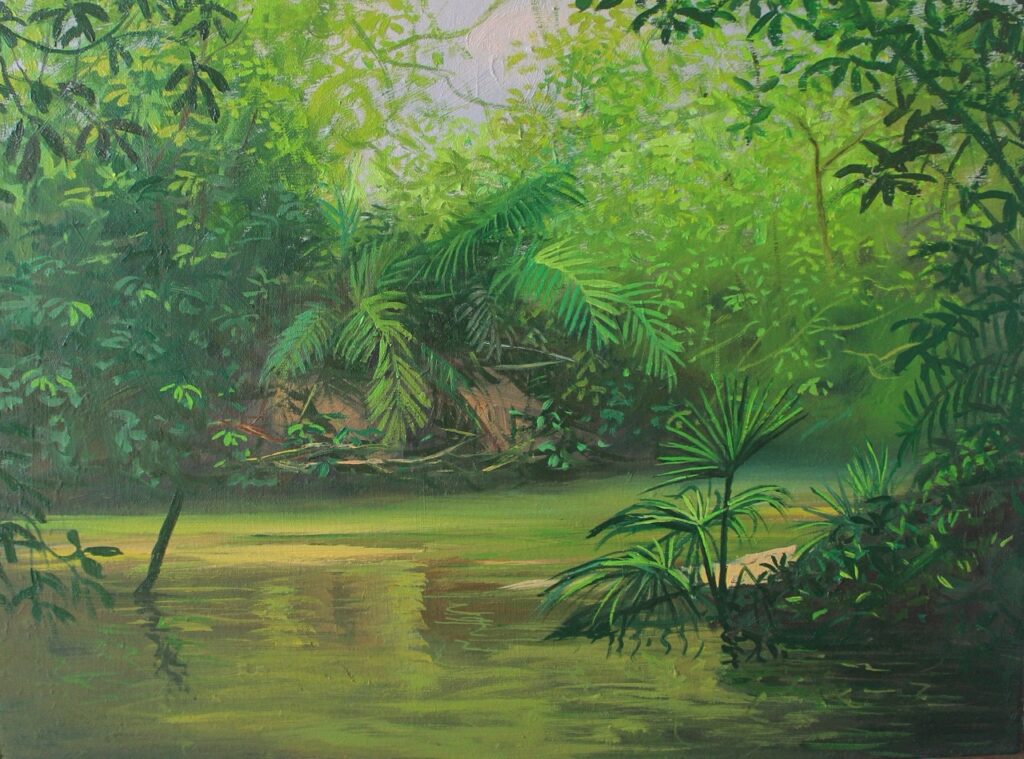
In painting Palmeira Acurí na beira do rio [Acurí palm on the riverbank], the artist chooses to remain faithful to a specific place. The painting is inspired by a stretch of river in Chapada dos Guimarães (MT), where he often goes to rest and “recharge his batteries”. “Sometimes I look at the landscape and feel that it is already finished”, he states.
His identification with the place and desire to imprint its energy on the canvas guide Miguel to continue working to better portray the location. The artist has returned to the same spot to observe its light, water, and atmosphere, and to create a second larger-scale work. “I want to go all around the river. I’m going around that little buriti tree on the right until I get to the other side of the river”, he says.
His decision to revisit the territory during the process reveals a significant exception in his practice: when lived experience is so powerful that it does not call for invention, only listening.
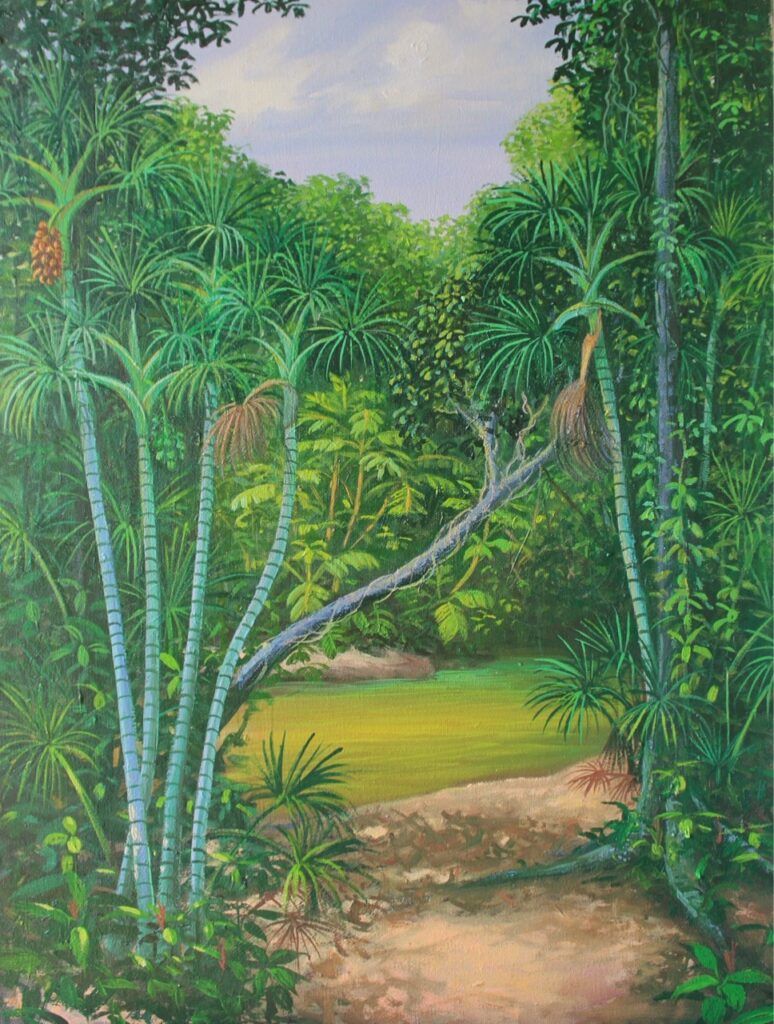
In painting Palmeira buritirana [Buriti palm tree], Miguel delves into his “new naturalism,” now depicting a palm tree that is similar to the buriti palm, but smaller in size and which grows in clumps, in a work built entirely from memory. In it, he combines landscapes which he has visited throughout his life, especially in indigenous villages and riverside regions.
“I have seen many buritirana trees on the riverbank”, the artist recalls. It is painted beside other species which Miguel knows intimately, portraying a forest that does not obey the logic of the territory, but rather that of experience. Here, imagining is not about distorting reality, but about reorganizing memories, affections, and sensations into a new form of presence.
The art of Miguel Penha Chiquitano is an invitation to immerse ourselves in forests, whether natural or imagined, through which we are able to establish a connection of respect and admiration with them. As of March 2026, his works will also inspire the visual identity of the Concertation’s digital channels, expanding the dialogue between art and solutions for the forests in the Amazonian territory.